Main

Duck Hunters Chart New Waters

Agency Lake, November 16, 2007
me-on-tiller.jpg
Photographs courtesy of Don Archer

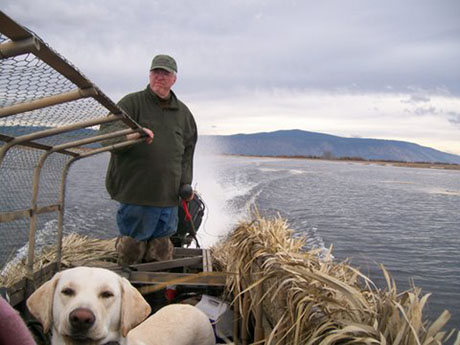
With the flooding of 2500 acres on Agency Lake (Upper Klamath Lake) by the Nature Conservancy, duck hunters have been probing and exploring the new terrain. Prior to the breaching of the dykes, I met an old duck hunter out on the lake one blue-bird day. We crossed paths on the open water and cut our engines to chat. He is in his mid-seventies, and he has been hunting the lake for over forty years. I candidly admitted that I had been lost in the fog twice that year and was contemplating buying a GPS. He was excited about the upcoming flooding and reclamation of old marsh. “Do you realize,” he said, “that we have the opportunity to study and chart the flight patterns of ducks and geese on uncharted grounds. Get a GPS and keep notes!”
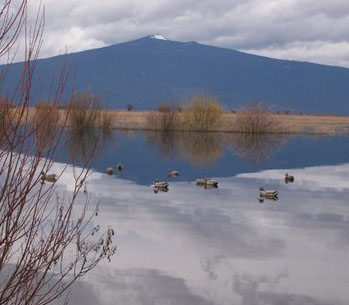
decoys.jpg

My first hunt was a disaster. I picked a partially submerged dyke with broken willows to back my grassed boat up against. In front of me I had a small body of water about twenty yards wide that followed the old dyke. This sliver of water ended up against a floating mat of straw that stretched for a half a mile. On the other side of this impenetrable tangle of mat, hundreds of birds flew in from the lake, crossed the new open water tracts and landed on the edges of the straw to rest. Six weeks into the season, the birds climbed high over every tree lined dyke. Probing the water I found depths of three to five feet on the edge of the vast swath of floating straw from the fall harvest. The next day I headed over to the Williams River area to find cover.

I positioned my boat in a cluster of willows with shallow water all around me. For the next three hunts, I did very well calling small flights of teal and lone mallards. I watched hunters at mid-day fire up their Mud Buddies and explore the area for back-water mallard water. My mid-November the large flights of teal zig-zagging across the new water seemed to disappear. The birds were not dropping into my stool and almost all of the flying birds were not responding to my calls. Even more frustrating, my boat was not positioned correctly for pass shooting. I watched enviously as some duck hunters fired at birds from their boat out in a maze of floating mat and tulle patches. As if I had eaten sour grapes for lunch, I told Don that they were probably shooting at divers.
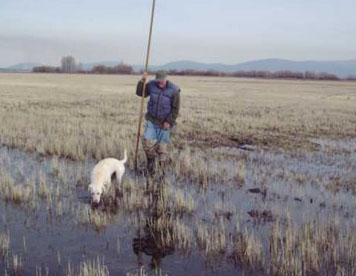
muck.jpg
Towards the Williamson River a few fields remain uncovered by water but without any cover.

Coming in from my last hunt with one bird in hand, I decided to get as close to the shallows as I could. Earlier I had observed that the eastern edges of this new tract met fallow grounds infested with tall weeds. On my first outings I had not disturbed any large concentrations of birds hiding in the thick maze. But this time my old friend Don Archer and I watched as mallards jumped from the edges as far back as a fifty yards in this weed, congested thicket. I looked for any tell-tale signs of a boat dragged into this cover, but I found no signs. I stood up on the highest position on my boat and yelled Eureka! I spotted a pot-hole in the jungle. Meanwhile, the birds we jumped were already circling back and dropping into the tangled web of brush and weeds. Moving down the shoreline I spotted another pot-hole and some dark silhouettes. “Oh, oh,” I said to Don. “I think I am looking at some decoys.” Just then a guy stood up and lifted both arms in the air in frustration. They had passed up firing on ducks directly overhead not wanting to give their secret location away to us. I gave a friendly gesture back and moved out of the area. At least he had not given me the middle finger salute. I have been very tolerant of exploring duck hunters stumbling onto my spread. After all, the flooding took place almost a month after the season opened. I hope this courtesy continues as duck hunters move in and out of the area trying to find good locations.
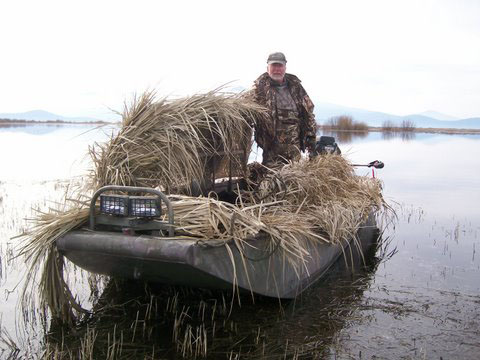
Don-boat.jpg
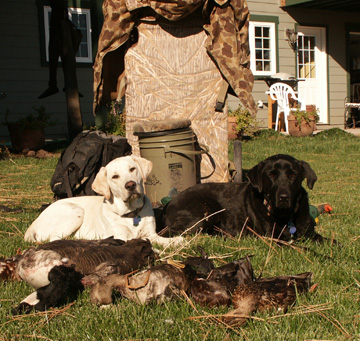
Don Archer waits for my lab Buddy to take a leak.

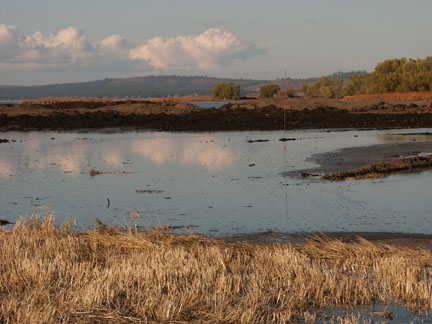
Initially I was worried that too many hunters would pour into the area. So far that has not been the case. Most of the newly flooded land is large tracts of open water adjoining the lake. Many of the local hunters still return to their favorite spots at the mouth of the Williamson River and along the tulle shores of the straits. With the exception of divers, mid season typically slows in the number of puddle ducks that stay in the area. I am just delighted, however, that in these times of high fuel costs, I have a new hunting area only a few miles from my home. It will be interesting to see how the new marsh comes to life with tulles and bulrushes. A spokesman for the Nature Conservancy said that in a test section the tulles came up in two years and in five years the test section had matured. So far I have only found three entrances through the “breached” dykes, although the tract can be accessed from the Williamson River. Any duck hunter worth his salt will find the “secret spots.” If we are tolerant of each other this season and demonstrate good manners in the marsh, all of us are going to have a lot of fun figuring out how to hunt this newly created marsh. Additional marsh will be created east of the Williamson River adjacent to Goose Bay. According to Matt Barry, project manager for the Conservancy, as reported in the Herald and News, November 19, 2007, 2200 additional acres will be flooded surrounding Goose Bay. Barry estimates that the water level will be lower than the other areas, which should attract puddle ducks. Best of luck!

Dave Archer
dave@glaciertoyellowstone.com

Williamson River Delta Restoration

Duck hunters, start your engines...
October 30, 2007

deltamap.jpg

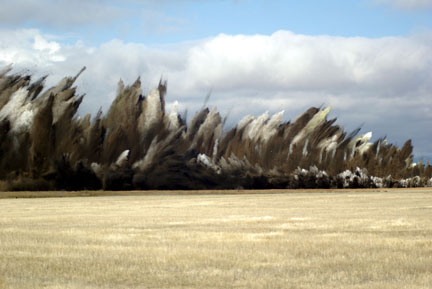
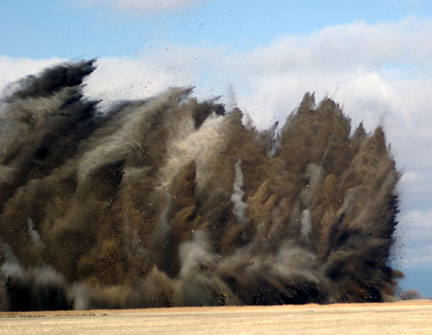
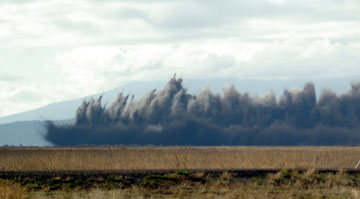
Mark Stern, Klamath Area Conservation Director for the Nature Conservancy, remarked that making a marsh was easy, “Just add water.” That and ten years of planning and engineering, 10 million in construction costs and 200,000 pounds of explosive reversed sixty years of farming practices to add 2,500 acres of new marshland to Upper Klamath Lake and Agency Lake. For thousands of year, the Williamson River deposited sediments across a vast delta where the river enters Upper Klamath Lake. However, in the 1950’s 22 miles of dikes were constructed around the delta and along the river to convert rich bottomland wetland soils into farmland. These barriers channeled the lower Williamson River directly into the lake, which eliminated extensive critical habitat for fish and wildlife, as well as a degradation of the lake’s water quality.

tom1.jpg


Stern described the shortnose and Lost River suckers, which are native fish only to the Klamath Basin, as the counterpart to the canaries in the mind shaft. Since the early 1990’s, fish and wildlife experts, including those from the National Academy of Sciences, have identified the restoration of the wetlands at the Williamson River Delta as one of the highest priorities for recovery of these two endangered fish, along with other fish and wildlife. Although the channel between Upper Klamath Lake and Agency Lake has always been a natural connection, The Williamson River prior to the 1940’s provided many side channels and marsh that connected the lake, which in turn provided sanctuary for larval fish fry to gradually move towards the lake as they migrated down river from their spawning beds upstream.

tom2.jpg

tom3.jpg

Photographs courtesy of Tom Templeton, copyright 2007

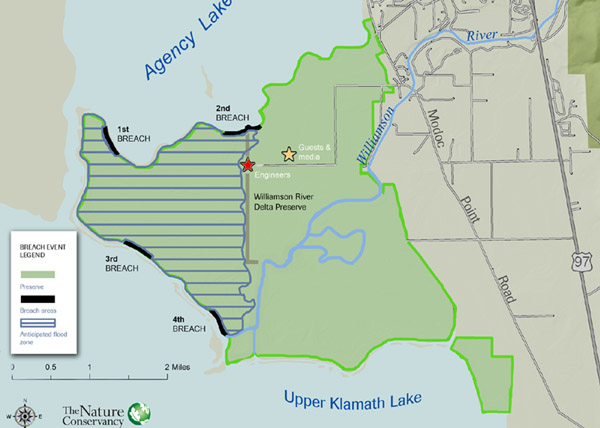
Matt Barry, Williamson River Delta Preserve Director for the Nature Conservancy, has managed the 6,800-acre wetlands project since 2005. In order to get the most bang for their bucks, Matt coordinated with the Bureau of Land Reclamation to create a computer model on the best spots to breach the existing levies. “We were looking for the best flow spots into the designated flooding area, and we had to assess fish movement, which meant we had to remove many interior levies prior to today’s explosive breaching of over two miles of existing levies.” Each of the four detonated areas ran for almost a half mile. Three thousand holes were dug twelve feet deep on alternating grids ten feet apart. Each hole was packed with 70 pounds of explosives along with boosters.

Adding 17,000 acre feet of water to Agency Lake, the newly flooded lands will offer anglers and waterfowl hunters new water to explore and map. The estimated depth of the newly flooded land is between two and five feet at full pool. Some areas have sunk over the past fifty years due to compressed peat moss and will provide some depressions 6 to 11 feet deep. Although there was some talk about anglers and hunters not being able to drop anchor and technically be trespassing, I talked to two officials who assured me that the issue was deemed by the Nature Conservancy as not being enforceable, although they will consider anyone leaving a boat and entering on private lands as trespassing. When I asked one official how long it would be before a duck hunter was hunting a flooded field, he looked at his watch and said, "Probably now." Gentlemen, I'll see you on the "new marsh."

Dave Archer

breach.jpg


Duck Opener '07

Agency Lake -- Buddy's First Retrieve!

Bug-geese-1.jpg

Can a young pup teach and old dog a new trick? Buddy, my seven month yellow lab, taught Max how to rumble with and retrieve a pissed off Honker on Sunday of the opener. I left Buddy home with Pauline on the opening day. I had invited Steve Barrows to join me, and I didn’t want to be distracted all morning disciplining Hyper-Baby. After my great success last year, I headed out on Saturday prior to opening day. Duck hunters were already out scouting one week in advance. When I climbed the levy to check out last year’s spot on the BLM land, I was disappointed to see dry fields. Last year numerous parties had set up on the corners of the Four-Mile Slough adjacent to Agency Lake. When I went to one of the corners, I could see only a feint trail leading up and over the dyke.

Climbing out of my boat and busting through the willows, I was surprised to see little water except for the long channel, which had very little cover. No one was around. I returned Wednesday, and still I found no established spreads or evidence of passage. I hiked out pulling a decoy cart about three-quarters of a mile and spread out a dozen duck decoys and eight floating honker decoys to hold my spot. A smaller channel drained into the main slough. The closest cover was forty-five yards from the main channel, but there was a small pocket of water that bulged from the drainage ditch just before dumping into the main channel. It seemed like as good a spot as any, but I was troubled that no one was around.

Friday I returned with another two dozen decoys and my portable blind and all the materials that I would need to hide two hunters and a dog. This time there was another boat, but I had no idea where they had headed. I set everything up for the next morning. Shooting time came and went without incident. Miles away everyone seemed to be enjoying themselves. The other party had walked another half mile past us, and they were very active. A few ducks flew by us along the water’s edge too far to shoot. I theorized that we would get some action mid-morning when fleeing ducks looked for quiet water. But then the geese started flying. We called one or two small flocks towards us for one or two passes, but each time they would flair or fly by us at about fifty yards. Finally, we saw four Canada Geese cross the channel about two hundred yards down from us. We called to them and pulled them in for five wide, looping passes. We were sure they would land, but then on the last pass they refused. Again, they crossed in front of us at about fifty yards. We picked up three ducks and then broke for a nap in the afternoon.

Sitting up from a rest, I watched as about a hundred mallards dropped into the field of tulles about two hundred yards behind us. I had rejected going into the tulles because the water slicks floating over the mud are treacherous and lethal to a lone hunter. Putting out my decoys two feet from the shoreline the previous day, I had dropped into the mud up to my chest. I could barely extricate myself. Fortunately, I could reach a rusted metal fence post to help me ashore.

I decided to explore. Steve found a willow staff and walked across two small rivets of mud. I was encouraged and left Steve in the blind and took Max out into the tulle field. Two hundred yards out I found inter-locking, skinny patches of water and jumped all those mallards, knocking down one drake. We set up six decoys there for the late afternoon. We had numerous mallards slip behind us, surprise us or land just out of range. The next day I decided to pick up my decoys and knock down the blind. I arrived late in the morning, after wandering in circles in the fog out on Agency Lake in my Gator-Trax boat and Mud-Buddy motor. Hyper-Baby and Max were out of control on my approach to the water slick. I didn’t dare yell at them as they got out of range for fear of jumping a bunch of birds. Both dogs were ahead of me and off to my left. Breaking out into the open, they put up about forty honkers.

I dropped down into some high grass and fumbled to shuck my decoy bag and un-sling my shotgun that was strung over my head. As luck would have it, a small group broke my way, and I had just enough time to rise up from my knees and dump one goose. I am a man with limited expectations, and low levels of success satisfy me in the field. I declared my weekend a success. I quickly selected a patchy island in this prairie pot-hole and tossed out a dozen dekes. Within twenty minutes I worked a flock of green-heads around my blind twice. They didn’t brake for a landing as they flew over me at twenty-yards. I decided I wanted to bring them in for a classic landing. I peeked up and could see their eyes, their beaks, their green heads, their feet, and of course, they could see me. Pale-white face with shinny glasses, say goodbye, dummy. Some duck hunters are destined to repeat the same old mistake over and over again.

Ten minutes later I called in a flock of geese. They made two passes, and locked their wings fifty yards out heading straight into my back. I squirreled down into the mud and watched their silent approach through heavy foliage of green tulles. Both of my dogs were frozen in place totally visible to the approaching B57 bombers. At 63 I am a bit slower to stand up from a squatting position. When I did rise and throw up my shotgun, the leaders were eye level at ten yards. Bang! I dropped a goose that broke to my right. I moved the barrel up into the sky to pick up a second goose. Bang! He wobbled but did not fold so I dropped him with my third shot. I have never taken three birds in the air on three shots. Had the second goose dropped with one shot, I believe I would have had my first triple, a feat that has eluded me with the exception of shooting out of a scull boat.

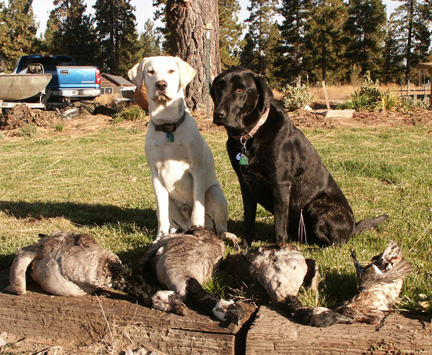
Both of the geese were up walking ten yards away having been shot with number two steel shot in three-inch casings. I couldn’t shoot them in the mud as my dogs were right on top of them. Buddy charged right at the closest goose and knocked the goose down with his chest. In his charge he lost his footing on impact and flipped over the goose. His feet flailed in the mud and air, and by the time he spun around, the goose charged him and boxed him with both wings. Buddy feinted and lunged at the goose, but not before he had been pecked and hissed at. Max, my timid eight-year old black lab who will not retrieve a wounded goose, jumped back out of the way of the brawl before him. He sat down and watched the fight safely out of the way.

Buddy had knocked the goose down twice, but each time the goose would jump to its feet and attack Buddy. Buddy was unflinching and kept charging the goose, knocking it down and then trying to grab a good hold. Each time he attempted to drag the goose across the mud, the goose would escape his hold and attack. At one point Buddy was dragging the goose by its ass while ignoring the pecks to his head. Finally Buddy nailed the goose by the neck and held the goose’s head under the water. The goose expired, and Buddy made his first retrieve dragging the goose ten yards to my feet. I set the two geese along the mud bank behind us and returned to the blind with the two dogs. Not to be out done, Max had run to the other cripple and brought him to me. Buddy would not let me hug or congratulate him. He stood sentry staring at the two geese. About five minutes later I saw Buddy jump to all fours. His goose had stood up and was walking out onto the mud flats! Before I could shoot it, Buddy charged, and it was round two. This time Buddy took him by the neck and dragged him back. I wrung the goose’s neck. I always shoot a wounded bird until it is dead. I never want a downed bird to experience fear and panic. At no time was I able to shoot either goose without endangering my dogs. The goose’s second demise, however, proved a valuable learning experience for Buddy. He took the goose by the neck and brought him to me. Hunting alone in the field just got safer. I won’t call Buddy anymore names like, Ugly Buddy, Hyper-Baby or Needle Nose. He’s my good old duck hunting Buddy!

Second Saturday of the Season

Sec-Sat.jpg

I packed light this time, and I carried everything on a cart, and yet I am still exhausted. I worked a flock of specs right over me with no goose decoys and dropped one. Later I brought in a large flock of Honkers. I could have had...should have had...might have had a double but I had only one shell in the gun! I was a great day, and in addition to the two geese I dropped four ducks. Max still refuses to retrieve a goose, although he will lead me through the tulles to the downed bird. Buddy was stubborn, uncooperative on the retrieves and bolting out of the blind, usually in the wrong direction, every time I shot. He was a pain in the ass, but I realize he is only seven months and we have much work ahead of us. At 63 I am feeling my age when I have to haul materials and supplies a mile out into the marsh. The cart helps, but the last 100 yards I have to haul everything on my back, and two geese and four ducks really adds to the load. I think I will design an aluminum cart with heavy bicycle tires or motorcycle tires. It will be a two-man cart pulled in the front and pushed from behind. It will have two swivel seats and a breakdown blind. I still haven't got around to painting my boat blind. Everyone I have talked to has done quite well on Agency Lake this year

If any duck hunter stumbles on this entry and has experience with carts, email me.

Dave Archer / dave@glaciertoyellowstone.com

Custom Built Aluminum Duck Sled

side.jpg

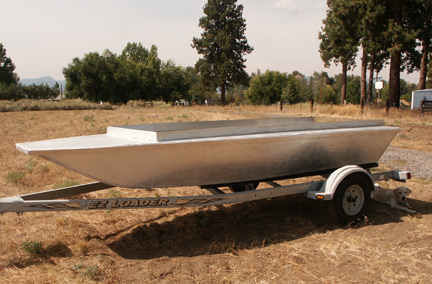
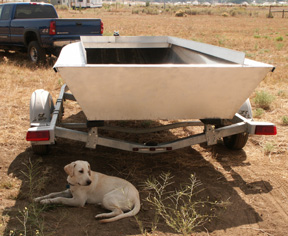
Length: 15’-3” to 17-feet
Bottom: 50”
Beam: 72”
Side Height: 19”
Height to Cockpit Rim: 23”
Bow deck: 45”
Cockpit width: 52-1/2”
Cockpit length: 11-feet
Aluminum thickness: 1/8” (All welded)

Bow2.jpg

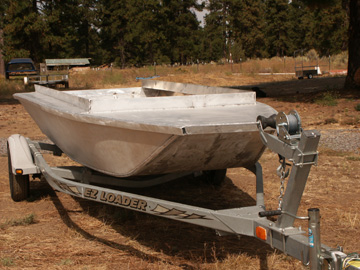
Mud Motor Ready!

Cost: The price of aluminum keeps climbing, and I do not get the cost discounts that large boat companies receive. I will sell my boat at comparable pricing. The advantage of buying my boat is that you gain the side decks and cockpit at no additional charge. I will also discount the removable and adjustable aluminum Duck-Boat Blind, if you order both the boat and blind. You also will save on shipping if you pick it up. Currently I am not Coast Guard Approved, although I anticipate I will have jumped through all their hoops and trials prior to the 2008 duck season. I will not be producing any boats during the 2007 duck season. Later I will post photographs of the boat painted with a Duck Boat Blind.

transom.jpg

September 16, 2007
Dave Archer
541-783-3796

Duck-Cart Blind

cart-no-grass.jpg

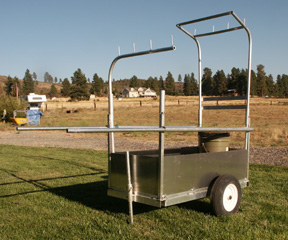
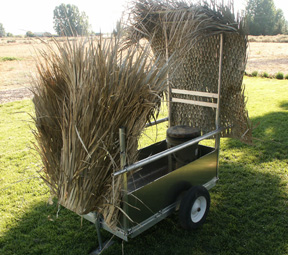
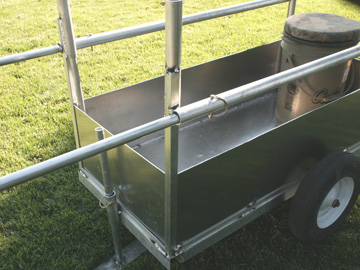
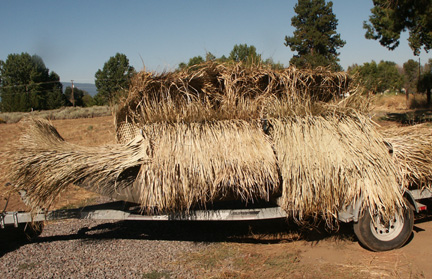
Here is a versatile duck-cart blind that can be used to haul trash cans to the curb or all your gear down a gated road. It can be built to fit the hunter. This one is just big enough to fit myself and a 75-pound lab. It is designed for a maximum water depth of 18 inches. Note that the handles retract and slide into a larger diameter pipe. The front opening swings open. Grass mats drop right over pegged pipes. Use burlap for the side profile. This model is tight and light at 23" x 48". The cost of this model unpainted is $600. Ask me about a 2-man model where the hunter in the rear pushes the blind-cart like a grocery cart.

cart-grass.jpg

cart-blind.jpg

Dave Archer
dave@glaciertoyellowstone.com
541-783-3796

Hi-Lo Duck Boat Blind

The Blast 'r Cast Solution

side-grass.jpg

Transome.jpg

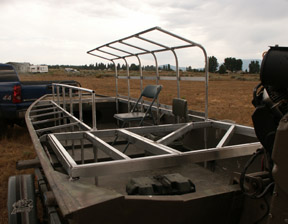
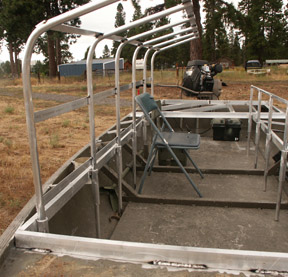
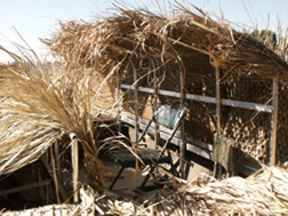
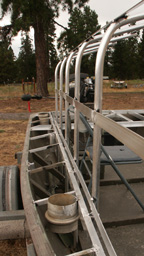
The Hi-Lo Duck Boat Blind has two great advantages. One – it is welded aluminum tube in 1-1/2 and 1-inch schedule 40 for durability and strength. The support platform is 2” channel, 1’x2” rectangular tubing and 1”x1” tubing. Two – the canopy and the front rail are both adjustable. Finally, the Hi-Lo Boat Duck Blind is detachable for the fishing season. As of fall 2007 a custom blind for a 16 to 18-foot boat is based on current aluminum pricing. ($603 just for the aluminum on the boat pictured below. )

Bow.jpg

chair.jpg

2007 Pricing for Hi-Lo Duck Blind (grass mats not included): $1,000 to $1500 depending on options.

Hi-Lo Duck Blind for 12-foot to 14-foot boats: $500 to $1,000 depending on options.

I require a 50% deposit and a two week time period to build the blind on your boat.

My home and shop is 100 yards from the Wood River Wetland entrance on Agency Lake. A final note - I include two aluminum field irrigation pipe segments for dropping in branches. If you want to move out from the shoreline, drop some tree branches in the slots!

Tree-camo-slot.jpg

Dave Archer
541-783-3796
39441 Modoc Point Road
Chiloquin, OR 97624
Email: dave@glaciertoyellowstone.com
Buddy1.jpg

Late Goose Season

Bros-keep.jpg

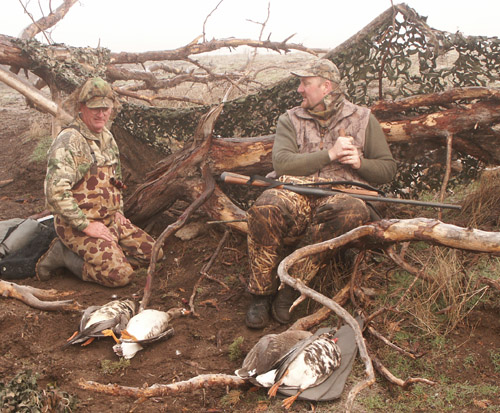
Goose hunting in March? You bet, and it’s legal if you hunt on private property for the special depredation hunt for White Front geese in Klamath County. The old refrain, “You should have been here last week,” was answered with a “We were, and we got skunked!” Two hunters and a fumbling cameraman and none of us fired a shot on our first hunt. But how sweet it was on this last day of a short, special hunt, and it was, indeed a special hunt. The Duck Commander would stroke his scraggly beard and nod his head in approval.

fourinflight.jpg


I joined Steve Barrow and his brother Cliff southeast of Klamath Falls on a piece of private property wedged between a couple of irrigation ditches and a nearly dry creek. The small rivulet opened up to form numerous shallow mud depressions, which drew in returning mallards. The previous weekend we placed our goose decoys around the shallow depression of the creek bottom, and huddled in a small washout. It was a bluebird day, and the only two birds that came in range chuckled as they looked down on us eating lunch and swapping old stories. Today was different, however. It had the foggy promise of a good shoot. Packing our gear across the field, we could hear the high pitched honks and cackles of birds directly overhead, invisible in the fog.

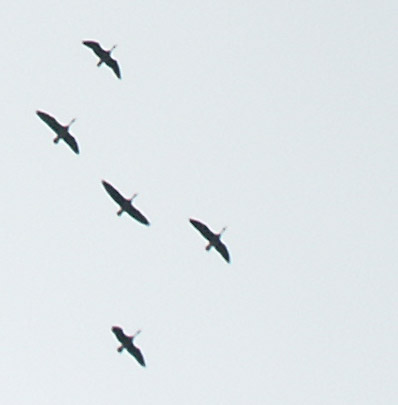
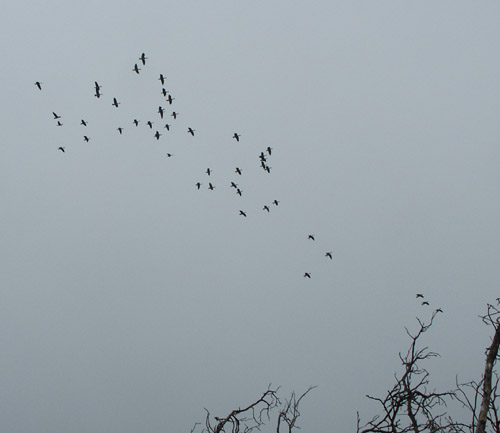
Steve suggested we place the decoys out in the field within shooting range of the shallow drop-off above the creek. We huddled beneath a lone and very large cedar. One of the trunks had broken off so we had some cover. As I had decided not to pay for an out of state license, I brought my camera. The barrow brothers had no sooner taken their position when multiple flights of geese dropped down below the fog and spotted our decoys. Three groups of twenty to thirty birds merged in one flight circling our sixty foot cedar. They split around the tree on both sides and dropped into the decoys. The Barrow men know how to shoot. In seconds both men had their two goose limit. And I stood under the tree gazing through the branches as geese dropped out of the sky. My camera was out of reach. It was classic, and the best part was that for the next three hours Steve and his brother called in small flights, one after another, hoping I could get some decent camera shots.

drop-in3.jpg

I had nothing but problems with my digital camera, but I had one of the best “hunting” experiences of my life. The Duck Commander would have had to film for days to capture the action we had in four hours.

Dave Archer