<?xml version="1.0" encoding="utf-8"?>
<feed xmlns="http://www.w3.org/2005/Atom">
    <title>Bass and Trout Fishing Digest</title>
    <link rel="alternate" type="text/html" href="http://www.bassandtroutfishingdigest.com/" />
    <link rel="self" type="application/atom+xml" href="http://www.bassandtroutfishingdigest.com/atom.xml" />
   <id>tag:www.bassandtroutfishingdigest.com,2010://1</id>
    <link rel="service.post" type="application/atom+xml" href="http://www.bassandtroutfishingdigest.com/cgi-bin/mt/mt-atom.cgi/weblog/blog_id=1" title="Bass and Trout Fishing Digest" />
    <updated>2008-11-03T04:16:48Z</updated>
    <subtitle>Exploring the West&apos;s Best Fishing and Camping Destinations</subtitle>
    <generator uri="http://www.sixapart.com/movabletype/">Movable Type 4.1</generator>
 

<entry>
    <title>Fishing in Sky Lakes Wilderness</title>
    <link rel="alternate" type="text/html" href="http://www.bassandtroutfishingdigest.com/fishing_in_sky_lakes_wilderness_1.htm" />
    <link rel="service.edit" type="application/atom+xml" href="http://www.bassandtroutfishingdigest.com/cgi-bin/mt/mt-atom.cgi/weblog/blog_id=1/entry_id=57" title="Fishing in Sky Lakes Wilderness" />
    <id>tag:www.bassandtroutfishingdigest.com,2008://1.57</id>
    
    <published>2008-11-03T04:12:57Z</published>
    <updated>2008-11-03T04:16:48Z</updated>
    
    <summary>Straddling the Cascade divide between Four Mile Lake and Crater Lake, the Sky Lakes Wilderness encompasses 113,590 acres. Six miles wide and twenty-seven miles long, the lake basins provide almost 200 lakes, although most are shallow and do not support...</summary>
    <author>
        <name>DavidArcher</name>
        
    </author>
    
    <content type="html" xml:lang="en" xml:base="http://www.bassandtroutfishingdigest.com/">
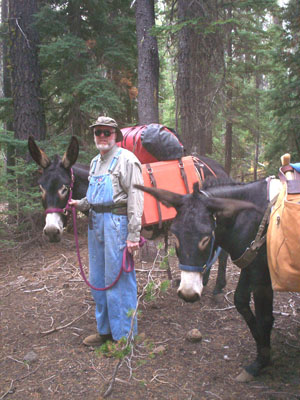
        <![CDATA[<p>Straddling the Cascade divide between Four Mile Lake and Crater Lake, the Sky Lakes Wilderness encompasses 113,590 acres.  Six miles wide and twenty-seven miles long, the lake basins provide almost 200 lakes, although most are shallow and do not support fish.  Some of the lakes are more aptly described as shallow ponds, and the average size lake is between 30 and 40 acres.  The largest lake is Fourmile Lake, which exceeds 900 acres and can be driven to from Highway 140.  It is not surprising than that I would pack into this wilderness on two occasions with my two pack donkeys, Harley and Lately, and get skunked because I didn't do my homework. <br />
<span class="mt-enclosure mt-enclosure-image" style="display: inline;"><img alt="me-boys.jpg" src="http://www.bassandtroutfishingdigest.com/me-boys.jpg" width="300" height="400" class="mt-image-none" style="" /></span></p>

<p>	To check on stocking programs for the area, I learned from Dan Van Dyke at ODFW that a number of lakes are stocked with fingerlings every other year from helicopter.  Of the Blue Canyon Group, Blue Canyon Lake, Carey Lake, and Horseshoe Lake are stocked.  In the Seven Lakes Group, Alta Lake, Cliff Lake, Grass Lake, Ivern Lake and Middle Lake are also stocked every other year.  Van Dyke went on to say that the growth of the fingerlings are slow, but it is not uncommon to catch rainbows and brooks up to seventeen inches with a string of moderate winters.</p>

<p>Statistics on the Lakes</p>

<p>Blue Canyon Group<br />
Blue Canyon Lake - 2.5 acres; 18-feet depth; elevation 6,340<br />
Carey Lake - 5 acres; 31-feet depth; elevation 6,020<br />
Horseshoe Lake - 20 acres; 18-feet depth; elevation 5,230</p>

<p>Seven Lakes Group<br />
Alta Lake - 32 acres; 13-feet depth; elevation 6,850<br />
Cliff Lake - 10-acres; 15-feet depth; elevation 6,340<br />
Grass Lake - 25 acres; 8-feet depth; elevation 6,040<br />
Middle Lake - 20 acres; 12-feet depth; elevation 6,120</p>

<p>Van Dyke commented that Grass Lake typically held the largest fish, but they are known to be picky. Middle Lake took second place for fish size.  Cliff Lake usually holds the smallest average sized fish, and the survival numbers go to Alta and Ivor Lakes.  I also spoke to Jeff Von Kienast, wildlife biologist at the Prospect Ranger District.  In years past both men have had good fishing in Grass Lake and Middle Lake.  Jeff said that he had success fishing Middle Lake on the far side of the lake, and that a number of years ago he did very well at Grass Lake.  Dan said that he took a number of Medford fly anglers into Grass Lake a few years ago and that anglers with float tubes did well while the shore anglers really struggled.<br />
<span class="mt-enclosure mt-enclosure-image" style="display: inline;"><img alt="Grasslake-2.jpg" src="http://www.bassandtroutfishingdigest.com/Grasslake-2.jpg" width="360" height="270" class="mt-image-none" style="" /></span></p>

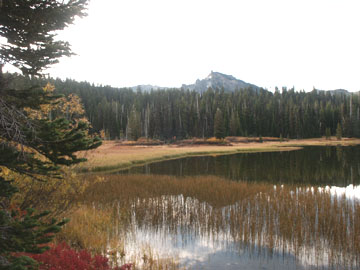
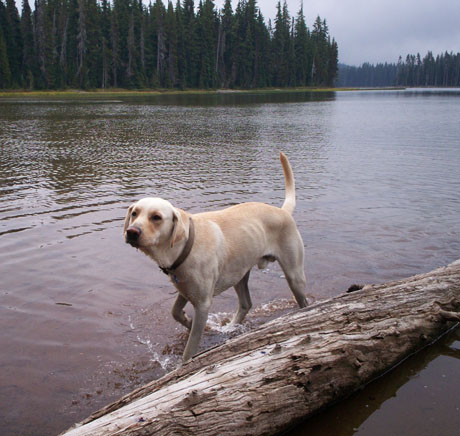
<p>	My first trip into the wilderness was from the trailhead at Fourmile Lake in early October, 2008.  Our destination was Long Lake.  We passed the first lake, and I noted that the shoreline was very shallow, and there was no way I could reach deeper water casting from shore.  It was a harbinger of what was yet to come.  Long Lake is beautiful, and we had a wonderful camping spot.  From every elevated vantage point, I could see the shallow bottom for thirty yards and more.  I never spotted a cruising fish.  For two days and two evenings, I never spotted a rising fish.  On October 25 I packed up the donkeys and headed into the Seven Lakes Basin.</p>

<p>	This trip started out badly when I discovered the perverse machinations of the Forest Service.  The Sevenmile Creek trailhead is two-fold - one for equestrian users and one for hikers.  "No trailers beyond this point" read the sign, so I pulled into the equestrian trailhead parking lot.  Towering above me was a steep mountain.  Up and up we went traversing the switch backs to the crest.  My mantra, taken from the children's book, The Little Engine that Could, began, "I think I can, I think I can, " and ended with sighs, coughs and grunts.  Up over the ridge we went and spiraled down slope until I could see a sparkling spot of blue peeking through the dark forest.  I was puzzled because I had only been hiking for fifty minutes, and my map showed no lake this early in the hike.  Trudging down the trail, the forest thinned enough for me to see a dark blue Ford truck.  Fifty-five minutes of hiking over a mountain top, and I had arrived at the hiker's trailhead!</p>

<p>	Further in I met a hiker carrying a spinning outfit.  He said that he had no luck at Grass Lake or Middle Lake, although he said that he had caught a few skinny fish at Cliff Lake.  I camped at Grass Lake late that afternoon.  From the hiker's trailhead, I made it to the lake in three hours, which included a 15 to 20 minute lunch break.  The sign at Grass Lake pointed to the trailhead at 6.5 miles.  Too pooped to fish, thanks to my extra hour of hiking, I studied the shoreline of Grass Lake and Middle Lake.  Like Long Lake, the shoreline was very shallow, and I could see mud for thirty to forty yards.  I never saw a rising fish that evening.  The next morning I fished Middle Lake casting as far as I could, but I had no luck.  The fact that I could not spot a single fish nagged me until I wondered if the severe winter of 2008 killed off a lot of fingerlings.<br />
<span class="mt-enclosure mt-enclosure-image" style="display: inline;"><img alt="Buddy-Long.jpg" src="http://www.bassandtroutfishingdigest.com/Buddy-Long.jpg" width="460" height="436" class="mt-image-none" style="" /></span><br />
	<br />
Dave Archer</p>]]>
        
    </content>
</entry>

<entry>
    <title>Duck Hunters Chart New Waters</title>
    <link rel="alternate" type="text/html" href="http://www.bassandtroutfishingdigest.com/waterfowl_hunting/duck_hunters_chart_new_waters.htm" />
    <link rel="service.edit" type="application/atom+xml" href="http://www.bassandtroutfishingdigest.com/cgi-bin/mt/mt-atom.cgi/weblog/blog_id=1/entry_id=55" title="Duck Hunters Chart New Waters" />
    <id>tag:www.bassandtroutfishingdigest.com,2007://1.55</id>
    
    <published>2007-11-18T21:01:55Z</published>
    <updated>2007-11-21T17:41:13Z</updated>
    
    <summary>Agency Lake, November 16, 2007 Photographs courtesy of Don Archer With the flooding of 2500 acres on Agency Lake (Upper Klamath Lake) by the Nature Conservancy, duck hunters have been probing and exploring the new terrain. Prior to the breaching...</summary>
    <author>
        <name>DavidArcher</name>
        
    </author>
    
        <category term="Waterfowl Hunting" />
    
    <content type="html" xml:lang="en" xml:base="http://www.bassandtroutfishingdigest.com/">
        <![CDATA[<p>Agency Lake, November 16, 2007</p>

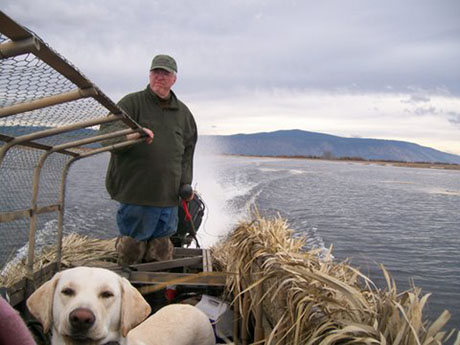
<p><img alt="me-on-tiller.jpg" src="http://www.bassandtroutfishingdigest.com/me-on-tiller.jpg" width="460" height="345" /><br />
Photographs courtesy of Don Archer</p>

<p>With the flooding of 2500 acres on Agency Lake (Upper Klamath Lake) by the Nature Conservancy, duck hunters have been probing and exploring the new terrain.  Prior to the breaching of the dykes, I met an old duck hunter out on the lake one blue-bird day.  We crossed paths on the open water and cut our engines to chat.  He is in his mid-seventies, and he has been hunting the lake for over forty years.  I candidly admitted that I had been lost in the fog twice that year and was contemplating buying a GPS.  He was excited about the upcoming flooding and reclamation of old marsh.  “Do you realize,” he said, “that we have the opportunity to study and chart the flight patterns of ducks and geese on uncharted grounds.  Get a GPS and keep notes!”</p>

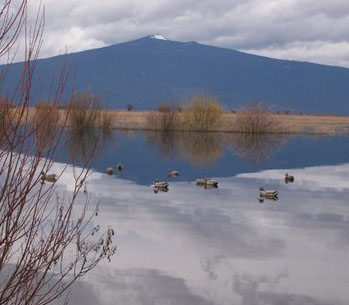
<p><img alt="decoys.jpg" src="http://www.bassandtroutfishingdigest.com/decoys.jpg" width="349" height="305" /></p>

<p>My first hunt was a disaster.  I picked a partially submerged dyke with broken willows to back my grassed boat up against.  In front of me I had a small body of water about twenty yards wide that followed the old dyke.  This sliver of water ended up against a floating mat of straw that stretched for a half a mile.  On the other side of this impenetrable tangle of mat, hundreds of birds flew in from the lake, crossed the new open water tracts and landed on the edges of the straw to rest.  Six weeks into the season, the birds climbed high over every tree lined dyke.  Probing the water I found depths of three to five feet on the edge of the vast swath of floating straw from the fall harvest.  The next day I headed over to the Williams River area to find cover.</p>

<p> I positioned my boat in a cluster of willows with shallow water all around me.  For the next three hunts, I did very well calling small flights of teal and lone mallards.   I watched hunters at mid-day fire up their Mud Buddies and explore the area for back-water mallard water. My mid-November the large flights of teal zig-zagging across the new water seemed to disappear.  The birds were not dropping into my stool and almost all of the flying birds were not responding to my calls.  Even more frustrating, my boat was not positioned correctly for pass shooting.  I watched enviously as some duck hunters fired at birds from their boat out in a maze of floating mat and tulle patches. As if I had eaten sour grapes for lunch, I told Don that they were probably shooting at divers.  </p>

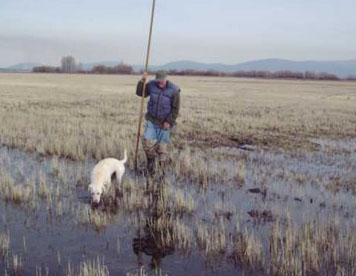
<p><img alt="muck.jpg" src="http://www.bassandtroutfishingdigest.com/muck.jpg" width="356" height="276" /><br />
 Towards the Williamson River a few fields remain uncovered by water but without any cover. </p>

<p>Coming in from my last hunt with one bird in hand, I decided to get as close to the shallows as I could.  Earlier I had observed that the eastern edges of this new tract met fallow grounds infested with tall weeds.  On my first outings I had not disturbed any large concentrations of birds hiding in the thick maze.  But this time my old friend Don Archer and I watched as mallards jumped from the edges as far back as a fifty yards in this weed, congested thicket. I looked for any tell-tale signs of a boat dragged into this cover, but I found no signs.  I stood up on the highest position on my boat and yelled Eureka!  I spotted a pot-hole in the jungle.  Meanwhile, the birds we jumped were already circling back and dropping into the tangled web of brush and weeds.  Moving down the shoreline I spotted another pot-hole and some dark silhouettes.  “Oh, oh,” I said to Don.  “I think I am looking at some decoys.”  Just then a guy stood up and lifted both arms in the air in frustration.  They had passed up firing on ducks directly overhead not wanting to give their secret location away to us.  I gave a friendly gesture back and moved out of the area.  At least he had not given me the middle finger salute.  I have been very tolerant of exploring duck hunters stumbling onto my spread.  After all, the flooding took place almost a month after the season opened. I hope this courtesy continues as duck hunters move in and out of the area trying to find good locations.</p>

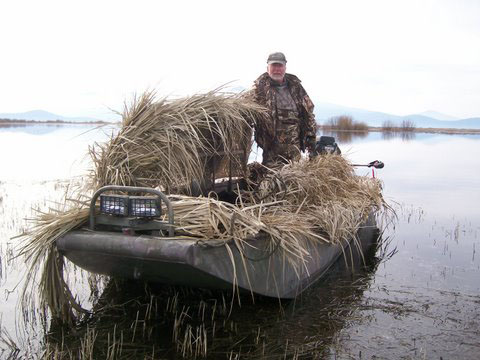
<p><img alt="Don-boat.jpg" src="http://www.bassandtroutfishingdigest.com/Don-boat.jpg" width="480" height="360" /><br />
 Don Archer waits for my lab Buddy to take a leak.</p>

<p>Initially I was worried that too many hunters would pour into the area.  So far that has not been the case.  Most of the newly flooded land is large tracts of open water adjoining the lake.  Many of the local hunters still return to their favorite spots at the mouth of the Williamson River and along the tulle shores of the straits.  With the exception of divers, mid season typically slows in the number of puddle ducks that stay in the area.  I am just delighted, however, that in these times of high fuel costs, I have a new hunting area only a few miles from my home.  It will be interesting to see how the new marsh comes to life with tulles and bulrushes.  A spokesman for the Nature Conservancy said that in a test section the tulles came up in two years and in five years the test section had matured.  So far I have only found three entrances through the “breached” dykes, although the tract can be accessed from the Williamson River.  Any duck hunter worth his salt will find the “secret spots.”  If we are tolerant of each other this season and demonstrate good manners in the marsh, all of us are going to have a lot of fun figuring out how to hunt this newly created marsh.  Additional marsh will be created east of the Williamson River adjacent to Goose Bay.  According to Matt Barry, project manager for the Conservancy, as reported in the Herald and News, November 19, 2007, 2200 additional acres will be flooded surrounding Goose Bay.  Barry estimates that the water level will be lower than the other areas, which should attract puddle ducks.   Best of luck!</p>

<p>Dave Archer<br />
dave@glaciertoyellowstone.com </p>

<p><br />
</p>]]>
        
    </content>
</entry>

<entry>
    <title>Upper Sacramento River</title>
    <link rel="alternate" type="text/html" href="http://www.bassandtroutfishingdigest.com/california_fishing_highway_395/upper_sacramento_river.htm" />
    <link rel="service.edit" type="application/atom+xml" href="http://www.bassandtroutfishingdigest.com/cgi-bin/mt/mt-atom.cgi/weblog/blog_id=1/entry_id=54" title="Upper Sacramento River" />
    <id>tag:www.bassandtroutfishingdigest.com,2007://1.54</id>
    
    <published>2007-11-12T22:24:23Z</published>
    <updated>2007-11-19T19:11:00Z</updated>
    
    <summary>One of California&apos;s Best Freestone Streams About 35 years ago while I was attending Sonoma State College and residing in Santa Rosa, I picked up the San Francisco Chronicle and read Jim Freeman’s outdoor column. He had just returned from...</summary>
    <author>
        <name>DavidArcher</name>
        
    </author>
    
        <category term="California Fishing / Highway 395" />
    
    <content type="html" xml:lang="en" xml:base="http://www.bassandtroutfishingdigest.com/">
        <![CDATA[<p><strong>One of California's Best Freestone Streams</strong></p>

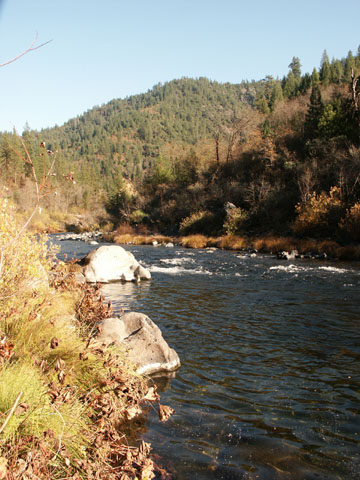
<p><img alt="Use3.JPG" src="http://www.bassandtroutfishingdigest.com/Use3.JPG" width="288" height="222" /></p>

<p>	About 35 years ago while I was attending Sonoma State College and residing in Santa Rosa, I picked up the San Francisco Chronicle and read Jim Freeman’s outdoor column.  He had just returned from a fishing trip on the Upper Sacramento River, and he outlined his success on the river fishing with Ted Fay, a Dunsmuir angler and fly tier who had gained a reputation as one of the most knowledgeable anglers on the Upper Sac.  Black and brown weighted Woolly Worms and Woolly Buggers in tandem dabbed and dropped along the sides of boulders both submerged and rising above the water column were tactics that produced then and will produce today.  The next weekend I rushed up to the Upper Sacramento River to Dunsmuir and located Ted Fay’s home.  Ted was on the river fishing, but his wife invited me inside.  I asked if I could buy a few of Ted’s flies.  The small living room was cluttered with fly tying equipment and supplies.  In the center of the living room was an “Archie Bunker” chair with a table and vise which faced the television.  <br />
	“Do you know what pattern, size, color that you want?” his wife asked. <br />
	 “No,” I replied.  “I only know how to fish with dry flies.  I’ll just take whatever you recommend.”<br />
	“Well, I would recommend whatever he has left next to his vise.  That’s what he will be using today.  When I returned home, I immediately ordered a Thompson vise and supplies from a Herter’s catalogue, and along with a book on fly patterns began copying my few remaining Ted Fay flies.  With the river’s recovery after the infamous chemical spill by the railroad in 1991, I could find little change.  What I did find was beautiful stretches of a small, freestone stream that stretches almost thirty-five miles from Lake Siskiyou to Lake Shasta.  The only difference I experienced was my own difficulty in wading and scrambling down embankments.  When I see men in their 70’s out in the middle of a rocky-bedded stream, I sigh with resignation uncertain if I will be able to do the same in ten years. </p>

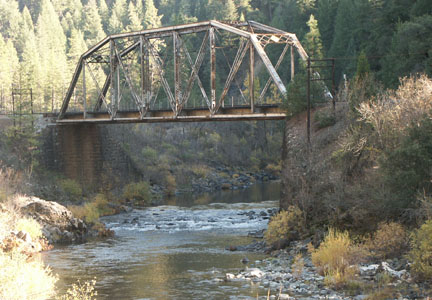
<p><img alt="use4.JPG" src="http://www.bassandtroutfishingdigest.com/use4.JPG" width="288" height="241" /></p>

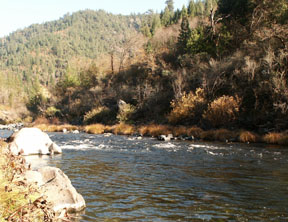
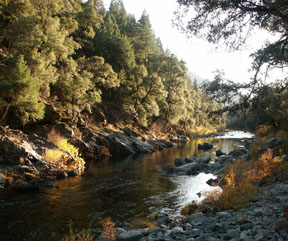
<p>	Although I trekked up and down the river in November and managed to catch a late afternoon caddis hatch and some lone giant October Caddis which put the little fish on the bite, most authorities recommend waiting for spring run-off to subside, noting that late May and June are the early summer kick-off months for fishing the Upper Sacs riffles, runs and beautiful pocket water.  Considering the vagaries of snow melt and arrival of insects, anglers in the early summer months are typically greeted by hungry trout and plentiful hatches of stoneflies, caddis and mayflies.  Wading in November, my cold, numb feet reminded me that the river is a tailwater, freestone river, and the water that comes out of the lake and drops down into the dark canyon remains cold, in spite of the balmy 70-degree air temperatures.  The river also gains more volume of water from tributaries before it meets the lake.</p>

<p>	With the help of the Shasta /Trinity Forest Service website, and the StreamTime map, <em>Upper Sacramento River Access</em>, I was able to discover numerous good access points right off Interstate 5.  The  Forest Service website also offers a hatch chart with suggested patterns courtesy of The Fly Shop.  Almost every exit off the interstate leads to good fishing waters.  I have included most of these exits.  The fishing map can be purchased at Ted Fay Fly Shop in Dunsmuir or The Fly Shop in Redding.  Ted Fay Fly Shop’s new address is 5732 Dunsmuir Ave., Dunsmuir, CA 96025, or they may be reached at (530) 235-2969.  www.tedfay.com.</p>

<p>http://www.fs.fed.us/r5/shastatrinity/recreation/st-main/st-fishing/rivers/upper-sacramento.shtml</p>

<p><strong><br />
Access Points Northbound on Interstate 5 from Lakehead to Box Canyon Dam above Dunsmuir</strong></p>

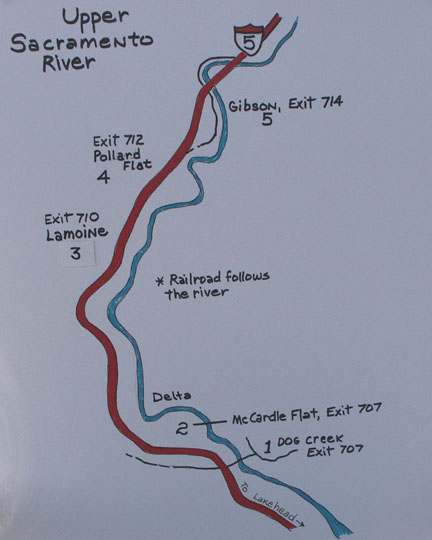
<p><img alt="map1-usac.jpg" src="http://www.bassandtroutfishingdigest.com/map1-usac.jpg" width="432" height="540" /></p>

<p>Note:  Much of the phrasing for directions is taken directly from the forest service website, which is not copyrighted.</p>

<p><strong>1.  Dog Creek:</strong> Traveling I-5 Northbound, take the Vollmers exit #707. Turn left on Dog Creek Road/Delta Road, and go under the freeway. Travel 0.3 miles and turn left on Fender Ferry Road. Travel approximately one mile down Fender Ferry Road under the freeway bridges, cross railroad tracks and cross a one-lane bridge over the Sacramento River.  Park along road after crossing bridge. Walk down the dirt road to the right for river access.  You will find some long runs and slow pools during low water.</p>

<p><strong>2.  McCardle Flat:</strong> Take Vollmers exit 707. Turn left onto Dog Creek Road/Delta Road. Turn right on Delta Road, then turn left onto McCardle Flat Road. Travel 1.0 mile down McCardle Flat Road and turn right onto a gravel road. Go approximately 0.4 miles down the graveled road and park in widened area near railroad tracks, or you may take the dirt road to the right that leads to a parking area downstream with a turn-around and a primitive spot for camping.  (The railroad track is very close for those of you who are light sleepers or have sleep disorders!)</p>

<p><strong>3.  LaMoine:</strong> Take the LaMoine exit. Travel 0.5 mile and turn left at first dirt road (across street from school bus sign on right). Dirt road forks, take right over bridge (Slate Creek). Travel approximately 0.2 miles on dirt road and park along road at top of hill. Walk down the dirt road to the left and head east to the river.</p>

<p><img alt="angler-red.JPG" src="http://www.bassandtroutfishingdigest.com/angler-red.JPG" width="288" height="259" /></p>

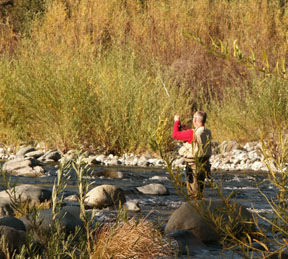
<p>I watched this angler catch two small trout in less than ten minutes on a small dry fly.</p>

<p><strong>4.  Pollard Gulch:</strong>  Take Pollard Flat exit. Turn right at the stop sign. Turn left on Eagle Roost Road. Take an immediate right and follow to a parking area for seven vehicles (Note: No parking spaces for large RVs or trailers).  This is a USFS picnic and day use site.  </p>

<p><strong>5.  Gibson: </strong>Take the Gibson exit #714. Follow the road as it circles over the freeway heading south; the road parallels the freeway heading south, then goes east under the freeway, and then parallels river. Park along Gibson Road and walk to river.  The further the road heads south, the higher the road is from the river.  If you continue, it will meet up with the Pollard Gulch access.</p>

<p><img alt="simsbridge.JPG" src="http://www.bassandtroutfishingdigest.com/simsbridge.JPG" width="288" height="460" /></p>

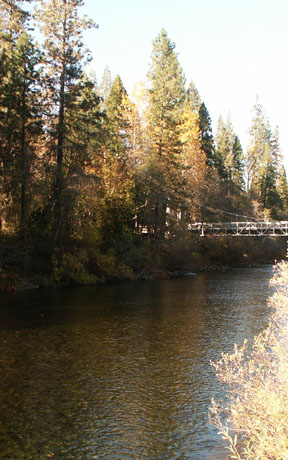
<p>Sims Footbridge, a Civilian Conservation Corp project</p>

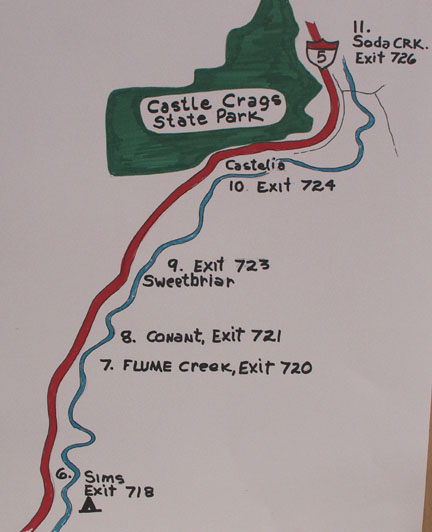
<p><img alt="map2-upsac.jpg" src="http://www.bassandtroutfishingdigest.com/map2-upsac.jpg" width="432" height="532" /></p>

<p><strong>6.  Sims:</strong> Take Sims exit #718. Turn right on Sims Road. Cross railroad tracks and bridge over Sacramento River to a parking lot near a pedestrian bridge. The Sims USFS campground is beautiful and right on the river.  The cost per night is $12, but the daily fee will rise to $15 for the 2008 season.  The campground closes on the last day of the general fishing season, November 16.  I really liked this old campground, but just at the base of the hill is a dirt road that leads back to some railroad land and a primitive camping area with shade.  Hey, when you are retired, these are the spots I look for to camp.  Right across the tracks is a mini rock gorge, and above it is some nice riffle and run water.  (I had some smaller trout torment me here.)</p>

<p><img alt="abovesims.JPG" src="http://www.bassandtroutfishingdigest.com/abovesims.JPG" width="360" height="480" /></p>

<p><strong>7.  Flume Creek Exit:</strong> Just before Flume Creek Exit #720, is a large pull-out just off Interstate-5.  Follow the open gated road down the hill and downstream along the railroad tracks to Flume Creek.  This area offers some great fly fishing water downstream, but I never checked upstream.</p>

<p><strong>8.  Conant:</strong> Take Conant Road exit 721. Turn right on Conant Road. Turn right at first dirt road. Park on the west side of railroad tracks. Walk east to the river.</p>

<p><img alt="conantbridge.JPG" src="http://www.bassandtroutfishingdigest.com/conantbridge.JPG" width="432" height="300" /></p>

<p><strong>9.  Sweetbriar: </strong> Take exit 723.  Trailers and RV’s are not advised on this paved road.  Do not cross the one-lane bridge.  Park before the bridge.  Here is a community that is open to sharing their section of water as noted on a sign.  Personally, I wouldn’t feel comfortable fishing with someone peering down at me from a deck as I muffed a cast or slipped on a rock.</p>

<p><strong>10.  Castle Crags State Park: </strong> Take the Castella / Castle Crag exit #724.  (Chevron gas station) The state run campground is open year-around on a self-register payment system of $15 per night and $6 for day use parking.  It has sites that will accommodate 27’ RV’s and 24-foot trailers, as well as tent camping.  During the summer it can be filled up.  For reservations call 1-800-444-7275.  The park also has a picnic site across the river.  Late in the fall there is not much water here, but in the summer it supposedly fishes very well. Fork up the six bucks because there is no other parking at the picnic site.</p>

<p><strong>11.  Soda Creek:</strong> Take the Soda Creek exit #726, about 2.5 miles below Dunsmuir.  I had two friendly residents of the area direct me to Soda Creek.  This was especially heart felt since I had a local give me the “Kiss-my-ass” gesture when I was exiting Scarlet Way!  Since I was stopped, I was puzzled by his animosity.  Was it the Oregon plates?  Well, there are assholes everywhere that don’t want to share.  I will remember the two people who gave me unsolicited fishing tips – thank you, guys.  Park in the dirt pull-out just before the bridge.  Walk downstream past the chained fence and follow the path to a curve in the river that offers a big pool up against a cliff at the base of a riffle.</p>

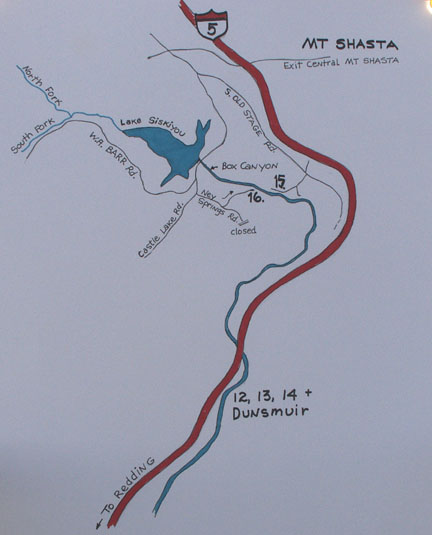
<p><img alt="map3-usac.jpg" src="http://www.bassandtroutfishingdigest.com/map3-usac.jpg" width="432" height="535" /></p>

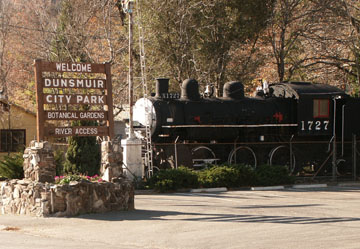
<p><strong>12.  Dunsmuir City Park:</strong> Traveling I-5 Northbound, take Central Dunsmuir exit. Turn left onto Dunsmuir Avenue. Travel 0.5 miles and turn left at "Dunsmuir City Park" sign. Follow the road down to the park.  Note: The town of Dunsmuir offers numerous access points to the river such as the I-5 Pool and the access at Financial Avenue.  Tauhindauli Park is in central Dunsmuir and a paved road leads down to the water.  No RV’s, buses or semi-trucks allowed.  (This is close to Ted Fay Fly Shop.)</p>

<p><img alt="DunCityPark.JPG" src="http://www.bassandtroutfishingdigest.com/DunCityPark.JPG" width="360" height="249" /></p>

<p><strong>13.  Scarlet Way, Dunsmuir:</strong> Take Central Dunsmuir exit. Turn left onto Dunsmuir Avenue. Travel 0.8 miles and turn left on Scarlet Way.  The road sign is easily missed, but you will see the brass metal sign for Shasta Retreat that arches over the road. Turn right on Cave Avenue. Cross river and railroad tracks, turn left after tracks to dirt parking area.  The road here is narrow and winds through a neighborhood.</p>

<p><strong>14.  Prospect Avenue, Dunsmuir:</strong> From the northbound lane of I-5, take the Dunsmuir Avenue exit #732.  Turn left at the stop sign.  Travel 0.3 miles and turn right on Prospect Avenue.  (Look for the Prospect Avenue Fishing Access sign.) Turn right when the road forks and proceed to the bridge and the parking area.  (Narrow road.)</p>

<p><img alt="Dunsmuir.JPG" src="http://www.bassandtroutfishingdigest.com/Dunsmuir.JPG" width="360" height="334" /></p>

<p><strong>15.  Cantara:</strong>   To locate the Cantera Fishing Access area, exit from I-5 at Central Mt. Shasta.  Turn left at the stop sign on Lake Street and proceed over the interstate until it intersects Old Stage Road.  Travel 2.5 miles and cross Azalea Road, veering right to continue on Old Stage Road. Travel 0.25 miles and turn right on Cantara Loop Road.  Follow the dirt road down some switch-backs to the dirt parking area. (Picnic area) Note: Just as you are descending down the road, you will note a road on the left with an open gate and no restrictive signs.  This rough road leads down to the railroad bridge in a picturesque meadow.  A commemorative sign acknowledges all the efforts that went into the clean up and restoration of the river after the chemical spill that took place in the vicinity.  I found a nice unimproved campsite with no restrictive signs, but don’t tell anyone I said you could “park” for the night.  This is a beautiful area, and if you are cautious and wary, you can hike the railroad tracks upstream or downstream to reach less pressured areas of the river.  Keep in mind, however, that some of the bridges and narrowing restrictions provide no escape for old farts like me who stumble along watching their feet.  When you are my age, you have to hark back to kindergarten warnings: stop, look and listen!</p>

<p><img alt="NewSpringsRD.JPG" src="http://www.bassandtroutfishingdigest.com/NewSpringsRD.JPG" width="432" height="324" /></p>

<p><strong>16.  Ney Springs:</strong>  Although the forks of the Upper Sacramento River above Lake Siskiyou offer small fish in small water, for all practicality the Upper Sacramento River is considered to be the outlet of Lake Siskiyou as it plunges out of the lake and down into the steep Box Canyon.  The basalt gorge is, practically speaking, impassable.  A couple miles down this twisting 100-foot steep walls of rock is the first access to the river.  Ney Springs, with its cold water pulled from the bottom of the lake and its infusion of cold spring water, offers a prolonged mayfly hatch during the summer.  Conversely, in the fall more optimum water temperatures may be found below the town of Dunsmuir.  To locate the Ney Springs access area, exit from I-5 at Central Mt. Shasta.  Turn left at the stop sign on Lake Street and proceed over the interstate until it intersects Old Stage Road.  (Directly ahead is a fish hatchery.)  Turn left on Old Stage Road and then veer right on W.A. Barr Road and cross over Box Canyon Dam.  In less than two-tenths of a mile, turn left on Castle Lake Road.  Take the first available left turn on a dirt road and travel 1.25 miles, and then turn left at sign that reads Cantara / Ney Springs Wildlife Area. The dirt road is narrow and leads down through a series of switch-backs.   (No camping restriction)</p>

<p><img alt="Ney2.JPG" src="http://www.bassandtroutfishingdigest.com/Ney2.JPG" width="288" height="384" /></p>

<p><strong>General Fishing Regulations 2007:</strong><br />
Open last Saturday in April to November 15<br />
Zone 1: Dam to Scarlet Way in Dunsmuir; zero trout, artificial lures, barb less hooks<br />
Zone 2: Scarlet Way to Sweetbriar – 5 trout, no special gear<br />
Zone 3: Sweetbriar to Lake Shasta – 2 fish, artificial lures, barb less hooks</p>

<p>Zone 2 and 3 are open during the winter with zero limits, artificial lures only and barb less hooks.<br />
Please read current regulations for any changes or restrictions.</p>

<p>Hey!  Yes, you! I’m writing all this stuff and wondering if anyone actually reads it.  I’d love to get some feedback on any of my articles.  Email dave@glaciertoyellowstone.com.  Thanks!</p>

<p><img alt="lake-siskiyou.JPG" src="http://www.bassandtroutfishingdigest.com/lake-siskiyou.JPG" width="432" height="268" /></p>

<p><br />
</p>]]>
        
    </content>
</entry>

<entry>
    <title>Tech Vest</title>
    <link rel="alternate" type="text/html" href="http://www.bassandtroutfishingdigest.com/product_reviews/tech_vest.htm" />
    <link rel="service.edit" type="application/atom+xml" href="http://www.bassandtroutfishingdigest.com/cgi-bin/mt/mt-atom.cgi/weblog/blog_id=1/entry_id=53" title="Tech Vest" />
    <id>tag:www.bassandtroutfishingdigest.com,2007://1.53</id>
    
    <published>2007-11-04T23:28:34Z</published>
    <updated>2007-11-04T23:36:59Z</updated>
    
    <summary>www.techvest.biz I recently purchased a high tech fishing vest that may be the organizational design that I have needed for over forty years of fly fishing. Designed by Les Zuck, a Montana native and ardent fly fisher, his Tech Vest...</summary>
    <author>
        <name>DavidArcher</name>
        
    </author>
    
        <category term="Product Reviews" />
    
    <content type="html" xml:lang="en" xml:base="http://www.bassandtroutfishingdigest.com/">
        <![CDATA[<p><a href="http://www.techvest.biz">www.techvest.biz</a></p>

<p><img alt="photo-vestfront_small.jpg" src="http://www.bassandtroutfishingdigest.com/photo-vestfront_small.jpg" width="240" height="209" /></p>

<p>I recently purchased a high tech fishing vest that may be the organizational design that I have needed for over forty years of fly fishing.  Designed by Les Zuck, a Montana native and ardent fly fisher, his Tech Vest accommodates all the gear you commonly need in a highly engineered compact vest.  I especially like the rod holder and the custom designed tool box in the center with four retractors for tools such as nipper and clamps. </p>

<p><img alt="photo-toolboxinvest.jpg" src="http://www.bassandtroutfishingdigest.com/photo-toolboxinvest.jpg" width="200" height="221" /></p>

<p> I hope you will visit the Tech Vest site.  You will note that on all three of my web sites I do not have product sponsors, and all the products that I endorse I paid cash for the product and enthusiastically endorse.  I have been waiting for a cloth vest to wear out for over fifteen years, but I couldn’t wait more years – I bought the Tech Vest.  Check out all the well thought out features.</p>

<p><img alt="float_tube_fishing.jpg" src="http://www.bassandtroutfishingdigest.com/float_tube_fishing.jpg" width="350" height="262" /></p>

<p><a href="http://www.techvest.biz">www.techvest.biz</a></p>]]>
        
    </content>
</entry>

<entry>
    <title>Williamson River Delta Restoration</title>
    <link rel="alternate" type="text/html" href="http://www.bassandtroutfishingdigest.com/waterfowl_hunting/williamson_river_delta_restoration.htm" />
    <link rel="service.edit" type="application/atom+xml" href="http://www.bassandtroutfishingdigest.com/cgi-bin/mt/mt-atom.cgi/weblog/blog_id=1/entry_id=52" title="Williamson River Delta Restoration" />
    <id>tag:www.bassandtroutfishingdigest.com,2007://1.52</id>
    
    <published>2007-10-31T00:43:17Z</published>
    <updated>2007-10-31T01:29:12Z</updated>
    
    <summary>Duck hunters, start your engines... October 30, 2007 Mark Stern, Klamath Area Conservation Director for the Nature Conservancy, remarked that making a marsh was easy, “Just add water.” That and ten years of planning and engineering, 10 million in construction...</summary>
    <author>
        <name>DavidArcher</name>
        
    </author>
    
        <category term="Waterfowl Hunting" />
    
    <content type="html" xml:lang="en" xml:base="http://www.bassandtroutfishingdigest.com/">
        <![CDATA[<p><strong>Duck hunters, start your engines...</strong><br />
October 30, 2007</p>

<p><img alt="deltamap.jpg" src="http://www.bassandtroutfishingdigest.com/deltamap.jpg" width="600" height="428" /></p>

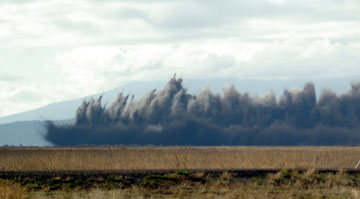
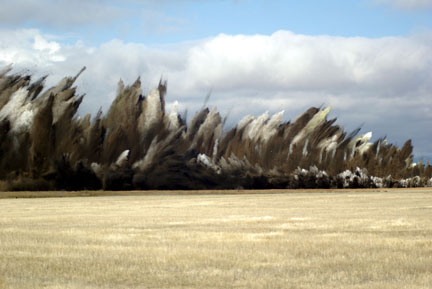
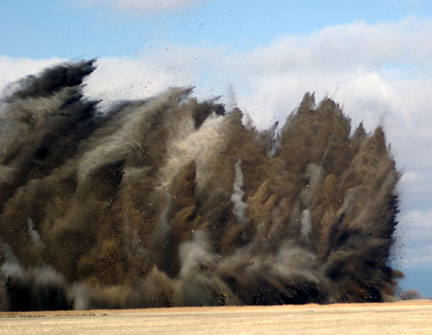
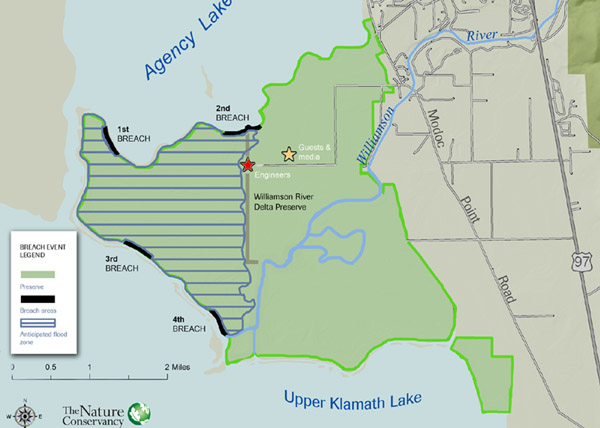
<p>	Mark Stern, Klamath Area Conservation Director for the Nature Conservancy, remarked that making a marsh was easy, “Just add water.”  That and ten years of planning and engineering, 10 million in construction costs and 200,000 pounds of explosive reversed sixty years of farming practices to add 2,500 acres of new marshland to Upper Klamath Lake and Agency Lake.  For thousands of year, the Williamson River deposited sediments across a vast delta where the river enters Upper Klamath Lake. However, in the 1950’s 22 miles of dikes were constructed around the delta and along the river to convert rich bottomland wetland soils into farmland.  These barriers channeled the lower Williamson River directly into the lake, which eliminated extensive critical habitat for fish and wildlife, as well as a degradation of the lake’s water quality.</p>

<p><img alt="tom1.jpg" src="http://www.bassandtroutfishingdigest.com/tom1.jpg" width="360" height="199" /></p>

<p><br />
	Stern described the shortnose and Lost River suckers, which are native fish only to the Klamath Basin, as the counterpart to the canaries in the mind shaft.  Since the early 1990’s, fish and wildlife experts, including those from the National Academy of Sciences, have identified the restoration of the wetlands at the Williamson River Delta as one of the highest priorities for recovery of these two endangered fish, along with other fish and wildlife.  Although the channel between Upper Klamath Lake and Agency Lake has always been a natural connection, The Williamson River prior to the 1940’s provided many side channels and marsh that connected the lake, which in turn provided sanctuary for larval fish fry to gradually move towards the lake as they migrated down river from their spawning beds upstream.  </p>

<p><img alt="tom2.jpg" src="http://www.bassandtroutfishingdigest.com/tom2.jpg" width="432" height="289" /></p>

<p><img alt="tom3.jpg" src="http://www.bassandtroutfishingdigest.com/tom3.jpg" width="432" height="335" /></p>

<p>Photographs courtesy of Tom Templeton, copyright 2007</p>

<p>	Matt Barry, Williamson River Delta Preserve Director for the Nature Conservancy, has managed the 6,800-acre wetlands project since 2005.  In order to get the most bang for their bucks, Matt coordinated with the Bureau of Land Reclamation to create a computer model on the best spots to breach the existing levies.  “We were looking for the best flow spots into the designated flooding area, and we had to assess fish movement, which meant we had to remove many interior levies prior to today’s explosive breaching of over two miles of existing levies.”  Each of the four detonated areas ran for almost a half mile.  Three thousand holes were dug twelve feet deep on alternating grids ten feet apart.  Each hole was packed with 70 pounds of explosives along with boosters.</p>

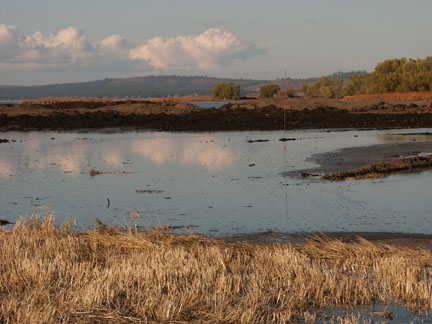
<p>	Adding 17,000 acre feet of water to Agency Lake, the newly flooded lands will offer anglers and waterfowl hunters new water to explore and map.  The estimated depth of the newly flooded land is between two and five feet at full pool.  Some areas have sunk over the past fifty years due to compressed peat moss and will provide some depressions 6 to 11 feet deep.  Although there was some talk about anglers and hunters not being able to drop anchor and technically be trespassing, I talked to two officials who assured me that the issue was deemed by the Nature Conservancy as not being enforceable, although they will consider anyone leaving a boat and entering on private lands as trespassing.  When I asked one official how long it would be before a duck hunter was hunting a flooded field, he looked at his watch and said, "Probably now."  Gentlemen, I'll see you on the "new marsh."</p>

<p>Dave Archer </p>

<p><img alt="breach.jpg" src="http://www.bassandtroutfishingdigest.com/breach.jpg" width="432" height="324" /></p>

<p><br />
</p>]]>
        
    </content>
</entry>

<entry>
    <title>Lower Sacramento River</title>
    <link rel="alternate" type="text/html" href="http://www.bassandtroutfishingdigest.com/california_fishing_highway_395/lower_sacramento_river.htm" />
    <link rel="service.edit" type="application/atom+xml" href="http://www.bassandtroutfishingdigest.com/cgi-bin/mt/mt-atom.cgi/weblog/blog_id=1/entry_id=51" title="Lower Sacramento River" />
    <id>tag:www.bassandtroutfishingdigest.com,2007://1.51</id>
    
    <published>2007-10-28T17:12:36Z</published>
    <updated>2007-10-31T13:44:34Z</updated>
    
    <summary>Redding, California - Oct. 25, 2007 The Sacramento River from Redding to Red Bluff So where does a former Montana fly fishing guide residing in Chiloquin, Oregon get his float fishing river fix. Perhaps the nearby Williamson River, maybe the...</summary>
    <author>
        <name>DavidArcher</name>
        
    </author>
    
        <category term="California Fishing / Highway 395" />
    
    <content type="html" xml:lang="en" xml:base="http://www.bassandtroutfishingdigest.com/">
        <![CDATA[<p><strong>Redding, California - Oct. 25, 2007</strong><br />
<strong>The Sacramento River from Redding to Red Bluff</strong></p>

<p><img alt="walk-bridge.jpg" src="http://www.bassandtroutfishingdigest.com/walk-bridge.jpg" width="432" height="324" /></p>

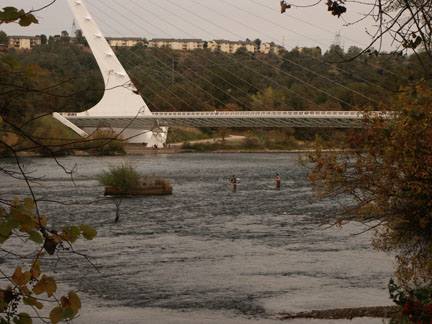
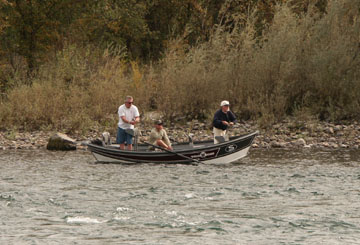
<p>	So where does a former Montana fly fishing guide residing in Chiloquin, Oregon get his float fishing river fix.  Perhaps the nearby Williamson River, maybe the Rogue or the Klamath or even the Trinity, but my choice will probably be the broad, big muscled lower Sacramento River.  Flowing from the Keswick dam at the outlet of Lake Shasta, the lower Sacramento River flows through the town of Redding on its way to the San Francisco Bay.  Miles of prime trout habitat line both sides of the river all the way down to Red Bluff.  Offering four separate salmon runs, along with steelhead, the trout are healthy and fat.  According to Michael Caranci, director of outfitters for The Fly Shop in Redding, California, when the dam operators were required to control flows and water temperatures to protect salmon runs and salmon fry, the trout benefited, and the fishing gets better year after year.  I met with Michael at The Fly Shop, which may be seen from I-5 just north of the Churn Creek Exit.  With October being their busiest month, Michael estimated they would finish the month with close to 400 trips.  In spite of the hectic flow of anglers asking to book if there were any cancellations and the phone ringing constantly, Michael took the time to describe and promote the lower Sacramento River.  I was impressed, but then maybe that is the reason The Fly Shop was voted the “Top Shop” by the fly fishing industry in 2003. </p>

<p><img alt="flyshop.gif" src="http://www.bassandtroutfishingdigest.com/flyshop.gif" width="432" height="204" /></p>

<p>	Two of the most productive months of the year are April and October.  March and April basically kick off the season with prolific hydropsyche caddis hatches.  The “Mother’s Day Caddis Hatch” bursts on the scene blanketing the air with millions of bugs on warm, sunny days.  Michael said, “The trout gorge themselves and eat, eat, eat, but the problem sometime becomes too many of the real thing surrounding an imitation.”  The caddis continue to hatch throughout the season and into the summer during the last hour of the day, which provides some good dry fly fishing.  Many guides, in spite of the hatches, continue to fish under the surface with sparkle pupas, peeking caddis, Bird’s Nest or bead-head nymphs in size 12 to 14, along with smaller emerger patterns.  In May sporadic “hatches” of salmonflies appear through out the system but not on a predictable basis.  Each year the salmonflies presence in the river grows.</p>

<p><img alt="driftboat.jpg" src="http://www.bassandtroutfishingdigest.com/driftboat.jpg" width="360" height="245" /></p>

<p>	With rising temperatures of summer often exceeding 100 in July and August, the pressure of anglers on the river wanes, but the fish continue feeding in water temperatures from 55 to 60 degrees.  I met a preacher working on his sermon on his tailgate at the Bonnyview Bridge near the water’s edge.  He said he liked fishing from his kick boat during the summer.  With his legs submerged in cold water and his torso absorbing the hot rays of summer, he said he experiences heaven and hell in the same moment.  He told me to emphasize to readers that sitting this close to the water was actually about ten degrees cooler.  He said he keeps himself hydrated with lots of water and very busy with good fishing.  Typically, however, the first and last hours are the most productive fishing of the day.  By late August the nights are cooling and day time temperatures began dropping to the nineties. </p>

<p><img alt="waders-bridge.jpg" src="http://www.bassandtroutfishingdigest.com/waders-bridge.jpg" width="360" height="365" /></p>

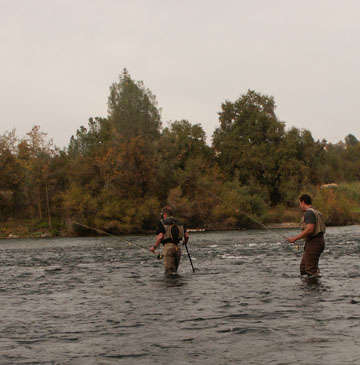
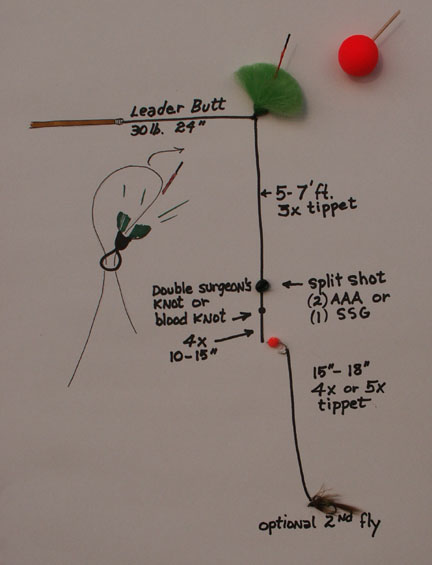
<p>	By September the first salmon runs appear.  By October the salmon are busy building reds and kicking up debris and dislodging nymphs.  The trout move in behind the spawning beds and feast on nymphs and the loose eggs that get washed downstream.  Michael described it as “salmon omelets.”  Michael advised me to be especially vigilant when wading so as to not disturb or destroy the beds, which are easily identified by the light-colored depressions in the gravel.  One successful technique to employ during October is a strike indicator, lead split-shot, a single egg pattern and one or two nymphs.</p>

<p><img alt="sac-setup.jpg" src="http://www.bassandtroutfishingdigest.com/sac-setup.jpg" width="432" height="565" /></p>

<p> In spite of the increased pressure during October and November, guides spread themselves out over seventy miles.  Michel stated thattypically by Thanksgiving or earlier the rains sweep up the valley and blow the river out below Cow and Cottonwood Creek, but it is rare that the upper stretch will be gone for more than a day or two at a time.  That is actually one of the big assets of the Lower Sac, that it remains a viable fishery almost all winter long.".  Most anglers wait for spring, but Michael pointed out that late winter on the lower Sacramento River offers good fishing between storm fronts.  The latter part of the winter does not have the impact on water flows that November and December experience.  Although air temperatures hold in the 50’s and 60’s and the fish slow in their feeding activity, more larger fish in the 18-inch range are caught during this time period with an added bonus of late winter baetis hatches.  By early spring trout are gorging themselves on alevin, salmon fry, and gaining up to one pound a month from these tiny fish with the egg sacks still attached.  If there is a dry fly period, it is in March and April when the caddis return and a new season is heralded. </p>

<p> 	To contact Michael and book a trip with The Fly Shop, you may reach him by phone at 1-800-669-3474 or at Michael@theflyshop.com or <a href="http://www.theflyshop.com">www.theflyshop.com</a></p>

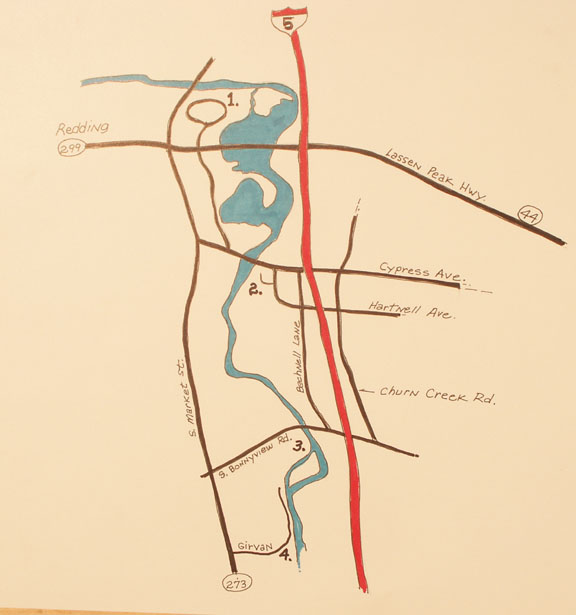
<p><strong>Launch Ramps and Access Points:</strong> Keep in mind that the time of year and the water levels flowing out of the dam determine whether wading is a viable option.  Because the current is so strong, I recommend inflatable suspenders and a wading staff.  For a detailed guide to the river, I recommend that you purchase the map, Sacramento River Fishing Access & Accommodations.  The map may be purchased at The Fly Shop in Redding or by visiting their web site at www.streamtime.com.  I welcome all scrutiny, corrections and advice, as this article will be a work in progress over the next year.  Contact David Archer at dave@glaciertoyellowstone.com</p>

<p><strong>2007 Shuttle Fees from The Fly Shop:</strong><br />
Posse Grounds as far as Sacramento RV Park…$25<br />
Posse Grounds to Anderson…$30<br />
As high as Bonnyview to Balls Ferry…$35<br />
As high as SAC RV to the Barge Hole (Balls Ferry road near old mouth of Battle Creek)<br />
…$40<br />
As high as Balls Ferry to Jelly’s…$45<br />
As high as Balls Ferry to Bend Bridge…$50 <br />
Add map 1</p>

<p><img alt="posse-launch.jpg" src="http://www.bassandtroutfishingdigest.com/posse-launch.jpg" width="360" height="212" /></p>

<p><img alt="map1.jpg" src="http://www.bassandtroutfishingdigest.com/map1.jpg" width="576" height="615" /></p>

<p><strong>1.	Posse Park Boat Launch + Wading:</strong> From I-5 take Highway 299 West and make a right onto Auditorium Drive (convention center).  You may also reach the Posse Grounds from Cypress Street by turning north on Park Marina Drive, which ends at the convention center.  This is the first launch past the A.C.I.D. Irrigation Dam a couple of miles below Lake Shasta’s Keswick Dam.  The launch site is behind the rodeo grounds near the convention center and provides good parking for all sized rigs and excellent access to Posse Riffle, as well as the numerous riffles and runs down to Redding’s famous Sundial Bridge.  During low water periods in the fall, wading anglers have numerous hot spots they may reach in a half mile stretch below the launch.  During the summer months the numerous shaded, picnic spots provide welcome relief when temperatures climb to three digits.  Turtle Bay Trail, across from the convention center and downstream from the launch, also provides access.  </p>

<p><img alt="warn-sign.jpg" src="http://www.bassandtroutfishingdigest.com/warn-sign.jpg" width="360" height="480" /></p>

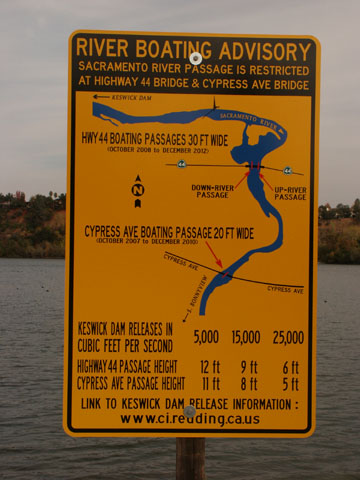
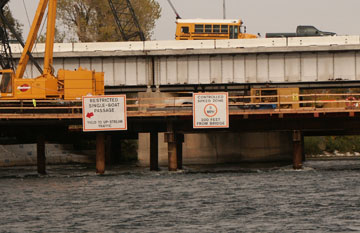
<p>Two of Redding’s bridges are under construction for the next couple of years.  The river has restricted passages in two places.</p>

<p><img alt="cypress-restric.jpg" src="http://www.bassandtroutfishingdigest.com/cypress-restric.jpg" width="360" height="233" /></p>

<p><img alt="cypressbridge.jpg" src="http://www.bassandtroutfishingdigest.com/cypressbridge.jpg" width="288" height="229" /></p>

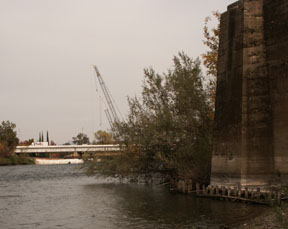
<p><strong>2.	Cypress Street Bridge Area:</strong> Exiting from I-5 onto Cypress Street in downtown Redding, move to the left lane and turn left on Hartnell at the light just short of crossing the bridge.  This is a business section.  Make the first right turn onto Henderson.  Look for the sign “Road Ends 400 feet ahead.” Turn right here and drive behind the businesses and park.  Take the dirt path towards the Cypress Street bridge or turn downstream fifty yards and fish the riffle and pool by the old bridge abutment.  This is a popular spot for the float fishing guides before they cross over and fish the western bank of the river.  Crossing the bridge, anglers will find some water above and below the bridge. </p>

<p><img alt="bonnyview.jpg" src="http://www.bassandtroutfishingdigest.com/bonnyview.jpg" width="360" height="270" /></p>

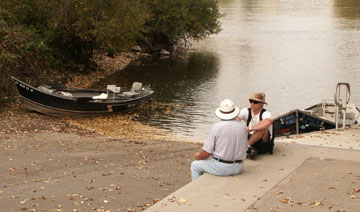
<p><strong>3.	South Bonnyview Road (Bridge) Launch:</strong>  This is an excellent boat launch and parking area, although it doesn’t provide good water for fly fishing in the near vicinity.  From Posse launch to South Bonnyview is a half day float.</p>

<p><strong>4.	Cascade Park:</strong>  Exit I-5 west on South Bonnyview Road.  Turn left on Market Street or Highway 273 and then left again on Girvan and proceed a short distance to Cascade Park.  I did not get far without waders.  The park is adjacent to islands, although the channel was very shallow.  South of the park is Niles Riffle, but I never made it – another time.</p>

<p><img alt="map2.jpg" src="http://www.bassandtroutfishingdigest.com/map2.jpg" width="432" height="439" /></p>

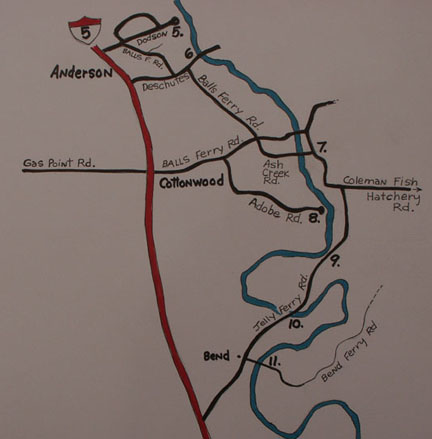
<p><strong>5.	Anderson River Park (launch):</strong> This is another spot that I missed.  The Fly Shop provides maps to local wading spots, and this is one of them.  South of Redding on I-5, take the Deschutes Road Exit (Factory Outlet Stores).  Go west and turn left (north) on Balls Ferry Road and then right on Dodson Lane to Anderson River Park.  Follow the trail down river for good riffles.  An improved boat launch is located on Rupert Road, which may be accessed from a loop off Dodson Lane.</p>

<p><img alt="deschutes.jpg" src="http://www.bassandtroutfishingdigest.com/deschutes.jpg" width="432" height="314" /></p>

<p><strong>6.	Deschutes Road Bridge:</strong> From I-5 take the Deschutes Road Exit a couple of miles east to the Deschutes Road Bridge. </p>

<p><strong>7.	Balls Ferry Bridge (Bridge) Launch:</strong> From I-5 take the Gas Point Road Exit and follow Balls Ferry Road until it intersects with Ash Creek (sharp corner).  Follow Ash Creek about a mile to the boat launch. (The bar here serves a good burger.)  It is five miles to Cottonwood, a quaint little town close to I-5.</p>

<p><strong>8.	Reading Island:</strong> From I-5 take the Gas Point Road Exit and follow Balls Ferry Road until it intersects with Adobe Road.  Turn right and proceed to the parking area less than two miles.  Maps are not always accurate; the public campground has been closed by the county, and the launch is only good during high flows onto a side channel, and even then for smaller boats. Now, I did talk to a lady who lived close by and was walking her dog.  She said she often sees fly fishermen casting on the main stem a short distance from the parking lot.  </p>

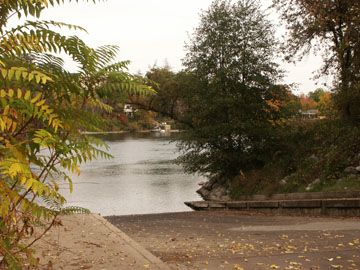
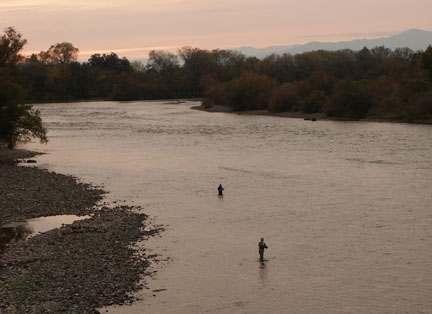
<p><strong>9.	Old Mouth Battle Creek (Launch and primitive camping):</strong>  The primitive camping is just that – primitive and rocky! Look for a drop off onto a dirt road.  There are a couple of water holes to cross, but they are solid underneath.  Nonetheless, after a rain this could be a potential mess without four wheel drive.  The beach is hard packed cobblestone, and during October it is a popular spot for local salmon anglers (especially during the weekend).  It is also a launch for boaters heading up to the Barge Hole just upstream.  This section offers a beautiful riffle that left me frustrated and perplexed.  I chalked it up to a full moon – not my skills!  I talked to two neighborhood river watchers who said that during the caddis hatches the riffle comes alive with trout just at dark.  From I-5 take the Jellys Ferry Road, cross the bridge and continue until you crest a plateau and see the river stretching out below you.  From the crest, some anglers hike down to the river and fish Lawrence Riffle.  As you drop off the crest down the slope, you will see on your left a long beach with a primitive boat launching spot.  Just ahead on the left in the trees is the turn-off to this primitive site.</p>

<p><img alt="jellys.jpg" src="http://www.bassandtroutfishingdigest.com/jellys.jpg" width="288" height="216" /></p>

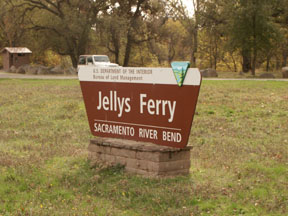
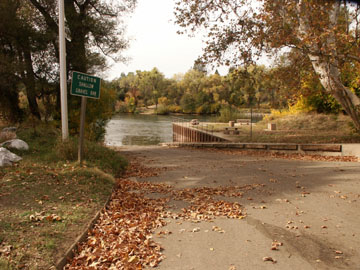
<p><strong>10.	Jellys Ferry Bridge (Launch):</strong> From I-5 take the Jellys Ferry Road to the bridge and parking area and boat launch.  (No camping.)  This is a rough boat ramp; during low water periods you will be launching in wet sand and mud.  I would recommend 4x4 vehicles after a rain.  The site is run by the Department of Interior, but it does not allow camping.</p>

<p><img alt="bendlaunch.jpg" src="http://www.bassandtroutfishingdigest.com/bendlaunch.jpg" width="360" height="270" /></p>

<p><br />
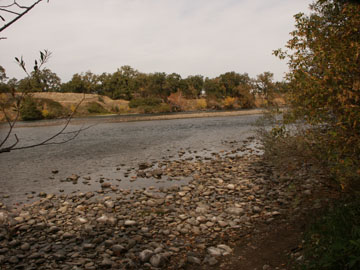
<strong>11.	Bend Bridge (Launch):</strong>  From I-5 take the Jellys Ferry Road Exit.  Turn right on Bend Ferry Road by the Bend RV Park (916-527-6289) and store and cross the bridge to a county launch site.  Fish the Lower Bend Riffle or take the trail on the north side of the parking lot to riffle water upstream.</p>

<p><img alt="bend-fence.jpg" src="http://www.bassandtroutfishingdigest.com/bend-fence.jpg" width="288" height="216" /></p>

<p><img alt="bend-riffle.jpg" src="http://www.bassandtroutfishingdigest.com/bend-riffle.jpg" width="360" height="270" /></p>

<p><strong>RV Camping Parks</strong></p>

<p><img alt="jgw-rv.jpg" src="http://www.bassandtroutfishingdigest.com/jgw-rv.jpg" width="288" height="216" /></p>

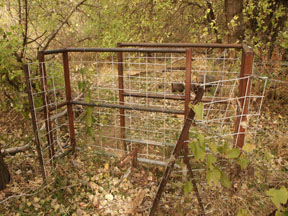
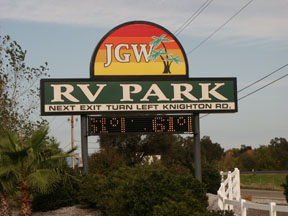
<p><strong>JGW RV Park:</strong> The JGW RV Park is located on Riverland Drive on the west side of Interstate-5, south of the Knighton Road exit.  Exit 673 is approximately five miles south of Redding.  (530) 365-7965.  Reservations: 1 800-469-5910.  www.jgwrvpark.com.  Email: jgwrvpark@charter.net.  (In the north corner of the park is a 5-strand, barb-wire fence.  Go around it at the river’s edge and walk upstream 100 yards to a great riffle, where I met a couple of fat rainbows.  The resort provides a rough boat launch.</p>

<p><img alt="sac-rv.jpg" src="http://www.bassandtroutfishingdigest.com/sac-rv.jpg" width="288" height="216" /></p>

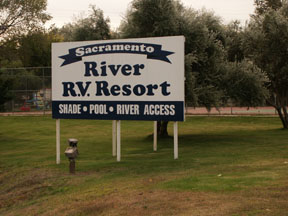
<p><strong>Sacramento River RV Resort:</strong> The Sacramento River RV Resort is located on Riverland Drive on the west side of Interstate-5, south of the Knighton Road exit next to JGW RV.  Exit 673 is approximately five miles south of Redding.  (530) 365-6402.  www.sacramentoriverrvresort.com.  Email info@sacramentoriverrvresort.com.  Beautifully shaded, the resort offers a concrete boat launch for high water conditions and a dirt launch for low water conditions. Launch fees for non-guests is a bargain $3. </p>

<p><strong>Marina RV Park:</strong> The Marina RV Park is located at 2615 Park Marina Drive.  Although it is not a park like setting with lots of shade, it is within walking distance to restaurants and movie theaters.  The launch fee for non-guests is $22.</p>

<p> </p>

<p></p>

<p>			<br />
</p>]]>
        
    </content>
</entry>

<entry>
    <title>Oregon Fishing Guide Book</title>
    <link rel="alternate" type="text/html" href="http://www.bassandtroutfishingdigest.com/book_and_article_reviews/oregon_fishing_guide_book.htm" />
    <link rel="service.edit" type="application/atom+xml" href="http://www.bassandtroutfishingdigest.com/cgi-bin/mt/mt-atom.cgi/weblog/blog_id=1/entry_id=49" title="Oregon Fishing Guide Book" />
    <id>tag:www.bassandtroutfishingdigest.com,2007://1.49</id>
    
    <published>2007-10-15T22:43:01Z</published>
    <updated>2007-10-15T22:44:01Z</updated>
    
    <summary> After spending almost twenty-five years exploring and fishing Montana, my retirement in Oregon poses a singular challenge. I don’t have the time or energy to fish all the waters of my new adopted state. I initially purchased a couple...</summary>
    <author>
        <name>DavidArcher</name>
        
    </author>
    
        <category term="Book and Article Reviews" />
    
    <content type="html" xml:lang="en" xml:base="http://www.bassandtroutfishingdigest.com/">
        <![CDATA[<p><img alt="OFSH_FinalCover_Re_Sampled.jpg" src="http://www.bassandtroutfishingdigest.com/OFSH_FinalCover_Re_Sampled.jpg" width="350" height="547" /><br />
After spending almost twenty-five years exploring and fishing Montana, my retirement in Oregon poses a singular challenge.  I don’t have the time or energy to fish all the waters of my new adopted state.  I initially purchased a couple of Oregon fishing guide books and found them helpful.  Craig Schuhman’s book, Moon Outdoors – Oregon Fishing, however, is my go-to-bible on Oregon fishing.</p>

<p>Having written a <a href="http://www.glaciertoyellowstone.com">Montana fly fishing and camping guide</a> a number of years ago, I am in awe of the expansive coverage Craig has included in his 470 page book.  The content is rich in details, and he does not generalize or gloss over hard to reach watersheds.  Having already explored a number of creeks and streams in southeast Oregon, I immediately went to the pages covering the upper Sprague River, the Sycan River, Thompson Reservoir, Dogg Lake and a number of other smaller fishing waters I had already covered.  Two of the books I had previously purchased gave fishing information that were inflated and generalized.  I tested Schuhman’s information with my experience, and his credibility soared.  Oregon Fishing is indeed a Complete Guide to Fishing Lakes, Rivers, Streams, and the Ocean. </p>

<p>Although I missed not seeing photographs in the guide book, once I began using the book, I was appreciative of the well thought out organization and keyed maps.  Each featured body of water covers the species of fish, facilities, directions and contact information for tackle shops and other related businesses in the area.  As a new resident in Oregon, I especially liked that I never got lost while I perused through the book.  Organized by geographical sections, each body of water is given a site name and number, along with a general location of the site in relation to the nearest town or landmark.  Under this information is a reference to the map with the page number.  If you are serious about fishing Oregon, this book is a must have guide book!</p>

<p>Dave Archer<br />
</p>]]>
        
    </content>
</entry>

<entry>
    <title>Duck Opener &apos;07</title>
    <link rel="alternate" type="text/html" href="http://www.bassandtroutfishingdigest.com/waterfowl_hunting/duck_opener_07.htm" />
    <link rel="service.edit" type="application/atom+xml" href="http://www.bassandtroutfishingdigest.com/cgi-bin/mt/mt-atom.cgi/weblog/blog_id=1/entry_id=48" title="Duck Opener '07" />
    <id>tag:www.bassandtroutfishingdigest.com,2007://1.48</id>
    
    <published>2007-10-08T18:04:08Z</published>
    <updated>2007-10-13T23:16:18Z</updated>
    
    <summary>Agency Lake -- Buddy&apos;s First Retrieve! Can a young pup teach and old dog a new trick? Buddy, my seven month yellow lab, taught Max how to rumble with and retrieve a pissed off Honker on Sunday of the opener....</summary>
    <author>
        <name>DavidArcher</name>
        
    </author>
    
        <category term="Waterfowl Hunting" />
    
    <content type="html" xml:lang="en" xml:base="http://www.bassandtroutfishingdigest.com/">
        <![CDATA[<p><strong>Agency Lake -- Buddy's First Retrieve!</strong></p>

<p><img alt="Bug-geese-1.jpg" src="http://www.bassandtroutfishingdigest.com/Bug-geese-1.jpg" width="432" height="355" /></p>

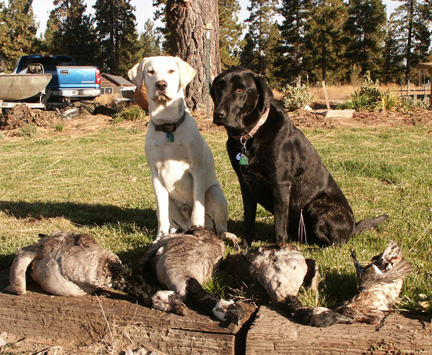
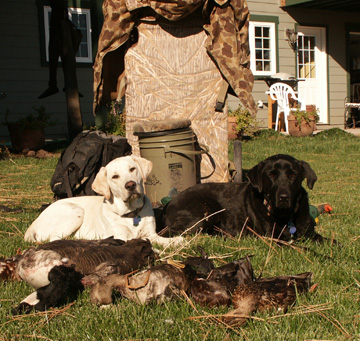
<p>Can a young pup teach and old dog a new trick?  Buddy, my seven month yellow lab, taught Max how to rumble with and retrieve a pissed off Honker on Sunday of the opener.  I left Buddy home with Pauline on the opening day.  I had invited Steve Barrows to join me, and I didn’t want to be distracted all morning disciplining Hyper-Baby.  After my great success last year, I headed out on Saturday prior to opening day.  Duck hunters were already out scouting one week in advance.  When I climbed the levy to check out last year’s spot on the BLM land, I was disappointed to see dry fields.  Last year numerous parties had set up on the corners of the Four-Mile Slough adjacent to Agency Lake.  When I went to one of the corners, I could see only a feint trail leading up and over the dyke.</p>

<p>Climbing out of my boat and busting through the willows, I was surprised to see little water except for the long channel, which had very little cover.  No one was around.  I returned Wednesday, and still I found no established spreads or evidence of passage.  I hiked out pulling a decoy cart about three-quarters of a mile and spread out a dozen duck decoys and eight floating honker decoys to hold my spot.  A smaller channel drained into the main slough.  The closest cover was forty-five yards from the main channel, but there was a small pocket of water that bulged from the drainage ditch just before dumping into the main channel.  It seemed like as good a spot as any, but I was troubled that no one was around.</p>

<p>Friday I returned with another two dozen decoys and my portable blind and all the materials that I would need to hide two hunters and a dog.  This time there was another boat, but I had no idea where they had headed.  I set everything up for the next morning.  Shooting time came and went without incident.  Miles away everyone seemed to be enjoying themselves.  The other party had walked another half mile past us, and they were very active.  A few ducks flew by us along the water’s edge too far to shoot.  I theorized that we would get some action mid-morning when fleeing ducks looked for quiet water.  But then the geese started flying.  We called one or two small flocks towards us for one or two passes, but each time they would flair or fly by us at about fifty yards.  Finally, we saw four Canada Geese cross the channel about two hundred yards down from us.  We called to them and pulled them in for five wide, looping passes.  We were sure they would land, but then on the last pass they refused.  Again, they crossed in front of us at about fifty yards.  We picked up three ducks and then broke for a nap in the afternoon.</p>

<p>Sitting up from a rest, I watched as about a hundred mallards dropped into the field of tulles about two hundred yards behind us.  I had rejected going into the tulles because the water slicks floating over the mud are treacherous and lethal to a lone hunter.  Putting out my decoys two feet from the shoreline the previous day, I had dropped into the mud up to my chest.  I could barely extricate myself.  Fortunately, I could reach a rusted metal fence post to help me ashore.  </p>

<p>I decided to explore.  Steve found a willow staff and walked across two small rivets of mud.  I was encouraged and left Steve in the blind and took Max out into the tulle field.  Two hundred yards out I found inter-locking, skinny patches of water and jumped all those mallards, knocking down one drake.  We set up six decoys there for the late afternoon.  We had numerous mallards slip behind us, surprise us or land just out of range.  The next day I decided to pick up my decoys and knock down the blind.  I arrived late in the morning, after wandering in circles in the fog out on Agency Lake in my Gator-Trax boat and Mud-Buddy motor.  Hyper-Baby and Max were out of control on my approach to the water slick.  I didn’t dare yell at them as they got out of range for fear of jumping a bunch of birds.  Both dogs were ahead of me and off to my left.  Breaking out into the open, they put up about forty honkers.</p>
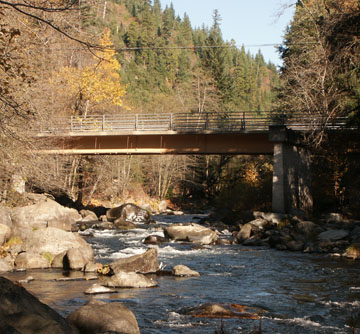
<p>I dropped down into some high grass and fumbled to shuck my decoy bag and un-sling my shotgun that was strung over my head.  As luck would have it, a small group broke my way, and I had just enough time to rise up from my knees and dump one goose.  I am a man with limited expectations, and low levels of success satisfy me in the field.  I declared my weekend a success.  I quickly selected a patchy island in this prairie pot-hole and tossed out a dozen dekes.  Within twenty minutes I worked a flock of green-heads around my blind twice.  They didn’t brake for a landing as they flew over me at twenty-yards.  I decided I wanted to bring them in for a classic landing.  I peeked up and could see their eyes, their beaks, their green heads, their feet, and of course, they could see me.  Pale-white face with shinny glasses, say goodbye, dummy.  Some duck hunters are destined to repeat the same old mistake over and over again.</p>
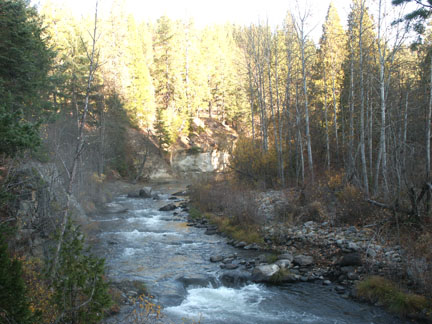
<p>Ten minutes later I called in a flock of geese.  They made two passes, and locked their wings fifty yards out heading straight into my back.  I squirreled down into the mud and watched their silent approach through heavy foliage of green tulles.  Both of my dogs were frozen in place totally visible to the approaching B57 bombers.  At 63 I am a bit slower to stand up from a squatting position.  When I did rise and throw up my shotgun, the leaders were eye level at ten yards.  Bang!  I dropped a goose that broke to my right.  I moved the barrel up into the sky to pick up a second goose.  Bang! He wobbled but did not fold so I dropped him with my third shot.  I have never taken three birds in the air on three shots.  Had the second goose dropped with one shot, I believe I would have had my first triple, a feat that has eluded me with the exception of shooting out of a scull boat.</p>

<p>Both of the geese were up walking ten yards away having been shot with number two steel shot in three-inch casings.  I couldn’t shoot them in the mud as my dogs were right on top of them.  Buddy charged right at the closest goose and knocked the goose down with his chest.  In his charge he lost his footing on impact and flipped over the goose.  His feet flailed in the mud and air, and by the time he spun around, the goose charged him and boxed him with both wings.  Buddy feinted and lunged at the goose, but not before he had been pecked and hissed at.  Max, my timid eight-year old black lab who will not retrieve a wounded goose, jumped back out of the way of the brawl before him.  He sat down and watched the fight safely out of the way.</p>

<p>Buddy had knocked the goose down twice, but each time the goose would jump to its feet and attack Buddy.  Buddy was unflinching and kept charging the goose, knocking it down and then trying to grab a good hold.  Each time he attempted to drag the goose across the mud, the goose would escape his hold and attack.  At one point Buddy was dragging the goose by its ass while ignoring the pecks to his head.  Finally Buddy nailed the goose by the neck and held the goose’s head under the water.  The goose expired, and Buddy made his first retrieve dragging the goose ten yards to my feet.  I set the two geese along the mud bank behind us and returned to the blind with the two dogs.  Not to be out done, Max had run to the other cripple and brought him to me.  Buddy would not let me hug or congratulate him.  He stood sentry staring at the two geese.  About five minutes later I saw Buddy jump to all fours.  His goose had stood up and was walking out onto the mud flats!  Before I could shoot it, Buddy charged, and it was round two.  This time Buddy took him by the neck and dragged him back.  I wrung the goose’s neck.  I always shoot a wounded bird until it is dead.  I never want a downed bird to experience fear and panic.  At no time was I able to shoot either goose without endangering my dogs.  The goose’s second demise, however, proved a valuable learning experience for Buddy. He took the goose by the neck and brought him to me.   Hunting alone in the field just got safer.  I won’t call Buddy anymore names like, Ugly Buddy, Hyper-Baby or Needle Nose.  He’s my good old duck hunting Buddy!</p>
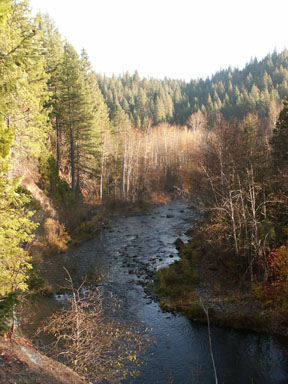
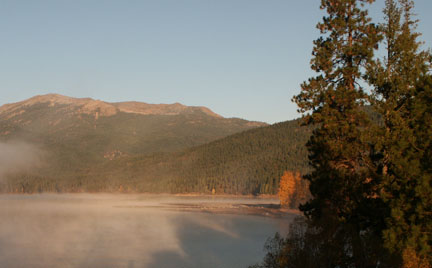
<p><strong>Second Saturday of the Season</strong></p>

<p><img alt="Sec-Sat.jpg" src="http://www.bassandtroutfishingdigest.com/Sec-Sat.jpg" width="360" height="341" /></p>

<p>I packed light this time, and I carried everything on a cart, and yet I am still exhausted.  I worked a flock of specs right over me with no goose decoys and dropped one.  Later I brought in a large flock of Honkers.  I could have had...should have had...might have had a double but I had only one shell in the gun!  I was a great day, and in addition to the two geese I dropped four ducks.  Max still refuses to retrieve a goose, although he will lead me through the tulles to the downed bird.  Buddy was stubborn, uncooperative on the retrieves and bolting out of the blind, usually in the wrong direction, every time I shot.  He was a pain in the ass, but I realize he is only seven months and we have much work ahead of us.  At 63 I am feeling my age when I have to haul materials and supplies a mile out into the marsh.  The cart helps, but the last 100 yards I have to haul everything on my back, and two geese and four ducks really adds to the load.  I think I will design an aluminum cart with heavy bicycle tires or motorcycle tires.  It will be a two-man cart pulled in the front and pushed from behind.  It will have two swivel seats and a breakdown blind.  I still haven't got around to painting my boat blind.  Everyone I have talked to has done quite well on Agency Lake this year</p>

<p>If any duck hunter stumbles on this entry and has experience with carts, email me.</p>

<p>Dave Archer / dave@glaciertoyellowstone.com</p>]]>
        
    </content>
</entry>

<entry>
    <title>Custom Built Aluminum Duck Sled</title>
    <link rel="alternate" type="text/html" href="http://www.bassandtroutfishingdigest.com/waterfowl_hunting/custom_built_aluminum_duck_sled.htm" />
    <link rel="service.edit" type="application/atom+xml" href="http://www.bassandtroutfishingdigest.com/cgi-bin/mt/mt-atom.cgi/weblog/blog_id=1/entry_id=47" title="Custom Built Aluminum Duck Sled" />
    <id>tag:www.bassandtroutfishingdigest.com,2007://1.47</id>
    
    <published>2007-09-16T21:26:42Z</published>
    <updated>2007-09-16T21:35:41Z</updated>
    
    <summary> Length: 15’-3” to 17-feet Bottom: 50” Beam: 72” Side Height: 19” Height to Cockpit Rim: 23” Bow deck: 45” Cockpit width: 52-1/2” Cockpit length: 11-feet Aluminum thickness: 1/8” (All welded) Mud Motor Ready! Cost: The price of aluminum keeps...</summary>
    <author>
        <name>DavidArcher</name>
        
    </author>
    
        <category term="Waterfowl Hunting" />
    
    <content type="html" xml:lang="en" xml:base="http://www.bassandtroutfishingdigest.com/">
        <![CDATA[<p> <img alt="side.jpg" src="http://www.bassandtroutfishingdigest.com/side.jpg" width="432" height="284" /></p>

<p>Length: 15’-3” to 17-feet<br />
Bottom: 50”<br />
Beam: 72”<br />
Side Height: 19”<br />
Height to Cockpit Rim: 23”<br />
Bow deck: 45”<br />
Cockpit width: 52-1/2”<br />
Cockpit length: 11-feet<br />
Aluminum thickness: 1/8”  (All welded)</p>

<p><img alt="Bow2.jpg" src="http://www.bassandtroutfishingdigest.com/Bow2.jpg" width="360" height="270" /></p>

<p>Mud Motor Ready!</p>

<p>Cost:  The price of aluminum keeps climbing, and I do not get the cost discounts that large boat companies receive.  I will sell my boat at comparable pricing.  The advantage of buying my boat is that you gain the side decks and cockpit at no additional charge. I will also discount the removable and adjustable aluminum Duck-Boat Blind, if you order both the boat and blind.  You also will save on shipping if you pick it up.  Currently I am not Coast Guard Approved, although I anticipate I will have jumped through all their hoops and trials prior to the 2008 duck season.  I will not be producing any boats during the 2007 duck season.  Later I will post photographs of the boat painted with a Duck Boat Blind.</p>

<p><img alt="transom.jpg" src="http://www.bassandtroutfishingdigest.com/transom.jpg" width="288" height="236" /></p>

<p>September 16, 2007<br />
Dave Archer<br />
541-783-3796<br />
</p>]]>
        
    </content>
</entry>

<entry>
    <title>Duck-Cart Blind</title>
    <link rel="alternate" type="text/html" href="http://www.bassandtroutfishingdigest.com/waterfowl_hunting/duckcart_blind.htm" />
    <link rel="service.edit" type="application/atom+xml" href="http://www.bassandtroutfishingdigest.com/cgi-bin/mt/mt-atom.cgi/weblog/blog_id=1/entry_id=46" title="Duck-Cart Blind" />
    <id>tag:www.bassandtroutfishingdigest.com,2007://1.46</id>
    
    <published>2007-09-12T00:51:22Z</published>
    <updated>2007-09-15T00:10:09Z</updated>
    
    <summary> Here is a versatile duck-cart blind that can be used to haul trash cans to the curb or all your gear down a gated road. It can be built to fit the hunter. This one is just big enough...</summary>
    <author>
        <name>DavidArcher</name>
        
    </author>
    
        <category term="Waterfowl Hunting" />
    
    <content type="html" xml:lang="en" xml:base="http://www.bassandtroutfishingdigest.com/">
        <![CDATA[<p><img alt="cart-no-grass.jpg" src="http://www.bassandtroutfishingdigest.com/cart-no-grass.jpg" width="288" height="240" /></p>

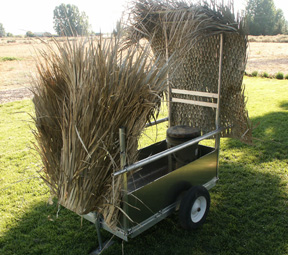
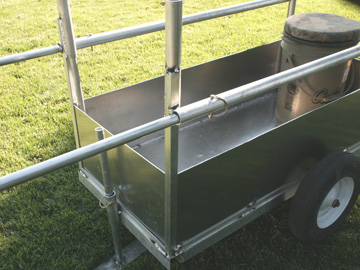
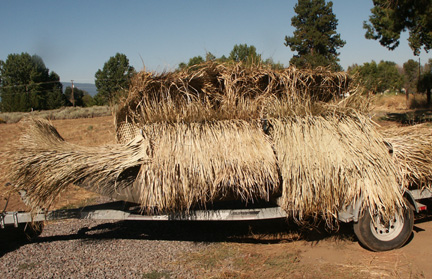
<p>Here is a versatile duck-cart blind that can be used to haul trash cans to the curb or all your gear down a gated road.  It can be built to fit the hunter.  This one is just big enough to fit myself and a 75-pound lab.  It is designed for a maximum water depth of 18 inches.  Note that the handles retract and slide into a larger diameter pipe.  The front opening swings open.  Grass mats drop right over pegged pipes.  Use burlap for the side profile.  This model is tight and light at 23" x 48".  The cost of this model unpainted is $600.  Ask me about a 2-man model where the hunter in the rear pushes the blind-cart like a grocery cart.</p>

<p><img alt="cart-grass.jpg" src="http://www.bassandtroutfishingdigest.com/cart-grass.jpg" width="288" height="255" /></p>

<p><img alt="cart-blind.jpg" src="http://www.bassandtroutfishingdigest.com/cart-blind.jpg" width="360" height="270" /></p>

<p></p>

<p>Dave Archer<br />
dave@glaciertoyellowstone.com<br />
541-783-3796</p>]]>
        
    </content>
</entry>

<entry>
    <title>Hi-Lo Duck Boat Blind</title>
    <link rel="alternate" type="text/html" href="http://www.bassandtroutfishingdigest.com/waterfowl_hunting/hilo_duck_boat_blind.htm" />
    <link rel="service.edit" type="application/atom+xml" href="http://www.bassandtroutfishingdigest.com/cgi-bin/mt/mt-atom.cgi/weblog/blog_id=1/entry_id=45" title="Hi-Lo Duck Boat Blind" />
    <id>tag:www.bassandtroutfishingdigest.com,2007://1.45</id>
    
    <published>2007-08-30T00:26:20Z</published>
    <updated>2007-09-15T00:08:45Z</updated>
    
    <summary>The Blast &apos;r Cast Solution The Hi-Lo Duck Boat Blind has two great advantages. One – it is welded aluminum tube in 1-1/2 and 1-inch schedule 40 for durability and strength. The support platform is 2” channel, 1’x2” rectangular tubing...</summary>
    <author>
        <name>DavidArcher</name>
        
    </author>
    
        <category term="Waterfowl Hunting" />
    
    <content type="html" xml:lang="en" xml:base="http://www.bassandtroutfishingdigest.com/">
        <![CDATA[<p><strong>The Blast 'r Cast Solution</strong></p>

<p><img alt="side-grass.jpg" src="http://www.bassandtroutfishingdigest.com/side-grass.jpg" width="432" height="279" /></p>

<p><img alt="Transome.jpg" src="http://www.bassandtroutfishingdigest.com/Transome.jpg" width="288" height="224" /></p>

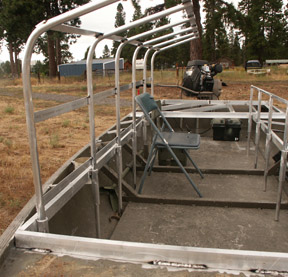
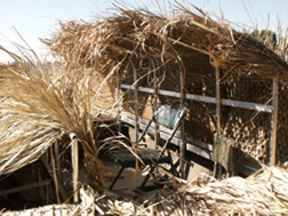
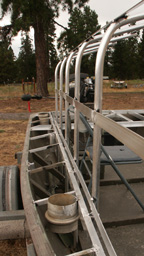
<p>The <strong>Hi-Lo Duck Boat Blind</strong> has two great advantages.  One – it is welded aluminum tube in 1-1/2 and 1-inch schedule 40 for durability and strength.  The support platform is 2” channel, 1’x2” rectangular tubing and 1”x1” tubing.  Two – the canopy and the front rail are both adjustable.  Finally, the Hi-Lo Boat Duck Blind is detachable for the fishing season.  As of fall 2007 a custom blind for a 16 to 18-foot boat is based on current aluminum pricing.  ($603 just for the aluminum on the boat pictured below.  )  </p>

<p><img alt="Bow.jpg" src="http://www.bassandtroutfishingdigest.com/Bow.jpg" width="288" height="277" /></p>

<p><img alt="chair.jpg" src="http://www.bassandtroutfishingdigest.com/chair.jpg" width="288" height="216" /></p>

<p><strong>2007 Pricing</strong> for Hi-Lo Duck Blind (grass mats not included):  $1,000 to $1500 depending on options.</p>

<p><strong>Hi-Lo Duck Blind for 12-foot to 14-foot boats</strong>: $500 to $1,000 depending on options.</p>

<p>I require a 50% deposit and a two week time period to build the blind on your boat.</p>

<p>My home and shop is 100 yards from the Wood River Wetland entrance on Agency Lake.  A final note - I include two aluminum field irrigation pipe segments for dropping in branches.  If you want to move out from the shoreline, drop some tree branches in the slots!</p>

<p><img alt="Tree-camo-slot.jpg" src="http://www.bassandtroutfishingdigest.com/Tree-camo-slot.jpg" width="144" height="256" /></p>

<p>Dave Archer<br />
541-783-3796<br />
39441 Modoc Point Road<br />
Chiloquin, OR 97624<br />
Email: dave@glaciertoyellowstone.com</p>

<p><img alt="Buddy1.jpg" src="http://www.bassandtroutfishingdigest.com/Buddy1.jpg" width="432" height="412" /></p>]]>
        
    </content>
</entry>

<entry>
    <title>Crane Prairie Explored</title>
    <link rel="alternate" type="text/html" href="http://www.bassandtroutfishingdigest.com/services_and_accommodations/oregon_fishing_and_camping_destinations/crane_prairie_explored_1.htm" />
    <link rel="service.edit" type="application/atom+xml" href="http://www.bassandtroutfishingdigest.com/cgi-bin/mt/mt-atom.cgi/weblog/blog_id=1/entry_id=44" title="Crane Prairie Explored" />
    <id>tag:www.bassandtroutfishingdigest.com,2007://1.44</id>
    
    <published>2007-08-12T21:18:51Z</published>
    <updated>2008-11-03T04:51:51Z</updated>
    
    <summary>Reconnoitering and Researching - August 10, 2006 Update- November 2, 2008 Scott Cook, owner of Fly and Field Shop , in Bend, Oregon recently gave a presentation to the Klamath Country Fly Casters, where he stated that great gains have...</summary>
    <author>
        <name>DavidArcher</name>
        
    </author>
    
        <category term="Oregon Fishing and Camping Destinations" />
    
    <content type="html" xml:lang="en" xml:base="http://www.bassandtroutfishingdigest.com/">
        <![CDATA[<p><strong>Reconnoitering and Researching - August 10, 2006<br />
</strong></p>

<p><img alt="Crane-map-2.gif" src="http://www.bassandtroutfishingdigest.com/Crane-map-2.gif" width="382" height="370" /></p>

<p><strong>Update- November 2, 2008</strong><br />
Scott Cook, owner of <em>Fly and Field Shop</em> , in Bend, Oregon recently gave a presentation to the <em>Klamath Country Fly Casters</em>, where he stated that great gains have been made at Crane Prairie Reservoir for the future of those famous Cranebows.  The bass populations have leveled, and the average bass size has declined.  One reason for this success has been the stocking of larger trout, which can escape the predatory jaws of bass.  With the average size of rainbows reaching between 17 and 19-inches, stomach contents of both bass and trout show that the stickleback minnow has two predators now!  So, keep this in mind as you read the following disaster story, which may indeed have a happy ending. <em> Northwest Fly Fishing</em> magazine has a feature article on Crane Prairie in their November/December 2008 edition.</p>

<p>2006<br />
A pox on every fishing guide writer and publisher who keeps regurgitating the same old glorification of a famed fly fishing water that has devolved into an ecological disaster!  A pox on every damned bucket biologist who denigrates or destroys a body of water for his own selfish fishing interest.  Having departed from my usual objective, quasi-journalistic writing style, be prepared as, "I'm mad as hell, and I am not going to take it anymore!"  Like most anglers, however, I am powerless.  So too it would seem,  short of using the poison, retenone,  are the government agencies that control our waterways.  This summer it has been particularly painful returning to Yellowstone Lake only to find that the lake trout have devastated the cutthroat fishery, or my sadness in returning to Rock Creek to witness the impact of Whirling Disease on one of my favorite creeks.  And now, when I finally get to Crane Prairie, I am told, "You should have been here in the 70's or 80's or even the early 90's.  </p>

<p><img alt="drownedtrees.jpg" src="http://www.bassandtroutfishingdigest.com/drownedtrees.jpg" width="288" height="227" /></p>

<p>Although some of the anglers I chatted with said that the lake was once again gradually improving, most said that they return to the lake to fish for larger, trophy size fish.  Some of the anglers that I spoke with have been fishing the lake for years and are local residents.  Most anglers now are bait fisherman who anchor their boats and fish the same spot for hours hoping to catch a solitary cruiser on power bait, worms, and dragon fly nymphs.  Bass fishermen work the drowned timber stands, and trollers motor up and down the channels.  What is missing is the large numbers of fly anglers who plied the lake.  I realize that it would seem pretentious for me to write an article based on one weekend of exploring, and yet the sadness of this story compels me to vent.  Perhaps I am in need of a catharsis after witnessing so many of these ecological disasters in a short span of time.  However, Crane Prairie is not all "Doom and Gloom."  The reservoir consistently produces huge trophy trout for anglers dedicated enough to learn its secrets.  I spoke to two such men.  One of the men spoke of spending five seasons on the lake before he could consistently catch trophy size trout.  Another man claimed he was still a learner after seven years.  Although most of the local guides have shifted to more productive waters to satisfy their clients need to catch numbers rather than trophies, a few guides have remained on the lake.  I have included the name of one guide that I met and chatted with briefly.  I include his contact information at the end of this article only because I ran into a couple who have hired him a couple of times and just gushed with praise for the man's skills and knowledge.  Let's start with an excerpt from the web site of Oregon's Department of Fish and Wildlife.</p>

<p>"Home of the famous "cranebows", Crane Prairie Reservoir is one of the top producing rainbow trout fisheries in Central Oregon. Rainbow trout here average 2 inches of growth a month during the summer. The record rainbow to date weighed over 19 pounds, with abundant rainbows in the 4 to 10 pound range. Crane Prairie Reservoir is a Wildlife Management Area. Osprey, bald eagle and many waterfowl frequent the area.  Crane Prairie Reservoir is located on the Deschutes National Forest and is a large, shallow impoundment on the upper Deschutes River approximately 30 miles southwest of Bend and is accessible from Century Drive (Forest Service Road 46), and Forest Roads 40, 42, and 4270. Crane Prairie was a natural meadow in which the Deschutes River, Cultus River, Cold Creek, Quinn River, Deer Creek, and Cultus Creek Converged. Crane Prairie Reservoir was first created in 1922 by rock filled dam and reconstructed by Bureau of Reclamation in 1940. The inundated trees and five square miles of shallow water coupled with cool water inlets make Crane Prairie Reservoir a very rich and productive aquatic system producing numerous trophy size rainbow trout.</p>

<p><strong>ODFW Management Policies for Crane Prairie Reservoir</strong></p>

<p>Oregon Department of Fish and Wildlife currently manages rainbow trout at Crane Prairie Reservoir for natural and hatchery production consistent with the Featured Species Fish Management Alternative for trout. Mountain Whitefish, brook trout, and kokanee are managed for natural and hatchery production consistent with the Basic Yield Management Alternative for trout. Largemouth bass shall be managed for natural production consistent with the Basic Yield Management Alternative for warm water fish."  </p>

<p>http://www.fs.fed.us/r6/centraloregon/recreation/fishing/lake-reservoir/craneprairie.shtml</p>

<p>Now, here are the facts never mentioned in fishing guide books or blurbs on promotional tourism sites.  In the mid 80's some bucket biologist dumped largemouth bass into Crane Prairie.  Although Crane Prairie has wild and sustaining populations of rainbows and Brook Trout, the bulk of the fish caught are planters.  Once the alarm cry was sounded about the growing bass population, they were already big, bold and hungry!  The 3-4 inch trout plants became bass chow.  The Oregon biologists steadfastly proclaimed that few of the transplanted trout were preyed upon by the bass.  Wishful thinkers theorized that the two populations would tend to gravitate to their own preferred waters.  The bass population flourished, and Crane Prairie established itself as one of Oregon's premier bass lakes.  Fly anglers gradually declined from their proportionately high numbers.  To add insult to injury, bucket biologists struck again introducing the Three-spined stickleback minnow, which many anglers that I spoke to feel are responsible for the crash of the damsel flies and dragon flies on the lake.  Here is an excerpt from an ODFW report found on-line.</p>

<p>"Three-spined stickleback have been present in Crane Prairie Reservoir since the early 1990s. This species was an illegal introduction and likely released to provide forage for warm water species in the reservoir which were also illegal releases. Schistocephalus is a common parasite in stickleback.  High productivity of the reservoir and conditions favorable for completing the tapeworm life history contribute to a high incidence of occurrence of the tapeworm in stickleback.   Fish samples collected in 2000 and 2001 were provided to ODFW pathologists for analysis. No incidence of Schistocephalus infection was found in fish species other than stickleback. Schistocephalus were found in digestive tracts of trout along with three-spined stickleback parts indicating that trout had ingested stickleback with parasite infestations. Largemouth bass diet studies have also shown secondary ingestion of Schistocephalus resulting from consumption of stickleback. [Now, note this disclaimer.] There is currently no evidence linking Schistocephalus occurrence to the decline of rainbow trout in Crane Prairie Reservoir."</p>

<p>To butcher an old folk song, "Where have all the rainbows gone, long time passing...." One government report stated that the illegal bass introduction "disturbed" the trout populations.  Disturbed - what an interesting word choice for a biologist to use.  It almost sounds, well, scientific!  What has been reported is a declining population of young bass and trout.  Terry Schrader from ODFW states that, "the stickleback [illegally dumped into the lake to provide forage for bass] out competes the young of these species and has also changed the dominant form of zooplankter."  This in turn has produced high levels of toxic cyanobacteria that is potentially fatal to pets and young children.  Another factor, similar to what happened in Diamond Lake with the illegal introduction of chubs, is the increased likelihood of algal blooms.  So, Mr. Bucket Biologist, what a fine mess you have got us into.</p>

<p>And now the good news.  Bass populations are in decline both in size and in numbers.  (I can not substantiate this statement, but it was a consensus.)  During the last two years ODFW has been planting trout from 8 to 9 inches.  These larger size plants have a greater life expectancy in escaping the jaws of large trout and bass.  I fished one entire day for bass in the north end of the lake by the resort.  I caught one bass.  The second day I explored the southern end of the lake and finally was able to locate some fly fishermen to interview.  Since I have no experience in catching trout or bass (yet), I have compiled the following information for first time anglers and campers to the lake.  It would seem prudent for anyone planning to fly fish Crane Prairie to go out with a guide. As I mentioned earlier in the article, I did meet one guide who was both friendly and helpful.  The next day I spoke to a couple who were heading out on the lake in a drift boat.  They spoke glowingly of the same guide, Brett Dennis.  He may be contacted at 541-598-0008.</p>

<p><strong>Camping:</strong> For RV camping with full hook-ups, contact Crane Prairie Resort at PO Box 1171, Bend, Oregon 97709. (541) 383-3939.  Located 33 miles from Bend and 20 miles from Sunriver, the resort offers full RV Hookups, boat rentals, tackle, gas, moorage, groceries, guide service and showers and laundry.  It is right next to the Forest Service Crane Prairie Campground.</p>

<p><img alt="CP-dock.jpg" src="http://www.bassandtroutfishingdigest.com/CP-dock.jpg" width="288" height="231" /></p>

<p><strong>Forest Service Campgrounds:</strong></p>

<p><strong>Crane Prairie Campground:</strong> Offering 146 sites and a boat launch at the northern end of the lake, the campground offers trailer and RV camping and a special designated tent camping section right on the lake.  The roads are paved and two boat launches are provided.  Users will need to pay a $5 use fee for launching their boats if they are not camped.  Premium sites cost $12 per night.  (2007)  Showers may be paid for at the adjoining resort.</p>

<p><strong>Quinn River Campground and Rock Creek Campground:</strong> Both campgrounds are located on the southern end of the lake off the Cascade Lakes Highway #46, which may be accessed from Highway 58 or from Bend.  Both of these campgrounds have boat ramps and places along the shore to moor your boat for the evening.  (Take in all your valuables at night as thefts occur.)</p>

<p><strong>Trout Fishing:</strong> I can't proffer any advise on fishing tactics other than what I have learned from chatting with fellow anglers over a two day period.  Here is what I learned.  Because the lake averages nine to eleven feet water depth, trout tend to seek sanctuary in the old river channels when water temperatures climb.  At the southern end of the lake, five river channels cross the broad body of water.  In the spring and fall the trout tend to disperse into cooler water.  With declining numbers of fish, target the channels exclusively during the summer months.  Seasoned anglers map holes and springs with GPS.  The channels are easy to locate if you have a fish finder that displays depth.  On my last day my step-son joined us.  As we cruised around looking at the channels and marking fish, I told him of a strategy I learned from bass anglers.  If you are fishing a lake arm with a river channel, use a series of buoy markers to mark the channel.  I pulled one out that I had bought from Cabela's.  Simply drop the weighted marking buoy overboard.  When the weight hits the bottom, the buoy stops unwinding, and you can turn the boat around and anchor.  Twenty minutes later I saw the splay of fly line shimmering in the skyline from an anchored boat.  When I glassed the boat, I spied a familiar fluorescent orange marker buoy.  Most fly fishers use large strike indicators with chironomid nymphs.  Other successful patterns are dragonfly nymphs, leech patterns and Woolly Buggers.  An excellent resource is Scott Richmond's book, <em>Crane Prairie - Deschutes Headwaters</em>, published by Frank Amato.</p>

<p><strong>Bass Fishing:</strong> Although I spotted a few bass fishermen in the Cultus Channel, the majority of bass anglers worked the drowned trees on the west side of the lake above and below the Quinn Channel.<br />
I hope to expand this article on my return trips when I begin work on a <a href="http://www.guidetohighway395.com">Highway 97 and High 395 </a>companion site.</p>

<p>Dave Archer</p>

<p> </p>

<p><br />
</p>]]>
        
    </content>
</entry>

<entry>
    <title>Fishing the Famed Waters of Klamath Basin with Sid Mathis</title>
    <link rel="alternate" type="text/html" href="http://www.bassandtroutfishingdigest.com/services_and_accommodations/oregon_fishing_and_camping_destinations/fishing_the_famed_waters_of_klamath_basis_with_sid_mathis.htm" />
    <link rel="service.edit" type="application/atom+xml" href="http://www.bassandtroutfishingdigest.com/cgi-bin/mt/mt-atom.cgi/weblog/blog_id=1/entry_id=43" title="Fishing the Famed Waters of Klamath Basin with Sid Mathis" />
    <id>tag:www.bassandtroutfishingdigest.com,2007://1.43</id>
    
    <published>2007-08-03T21:32:55Z</published>
    <updated>2007-08-13T04:55:32Z</updated>
    
    <summary>August 1, 2007 Our targeted hatch, often misidentified as a Green Drake or a Pale Morning Dun, was the genus, Emphemerella, the species doddsi. Leisurely gliding down the Williamson River in south-central Oregon, the dark green waters silhouetted the unmistakable...</summary>
    <author>
        <name>DavidArcher</name>
        
    </author>
    
        <category term="Oregon Fishing and Camping Destinations" />
    
    <content type="html" xml:lang="en" xml:base="http://www.bassandtroutfishingdigest.com/">
        <![CDATA[<p><strong>August 1, 2007	</strong></p>

<p><img alt="Sid-Fish.jpg" src="http://www.bassandtroutfishingdigest.com/Sid-Fish.jpg" width="360" height="261" /></p>

<p>	Our targeted hatch, often misidentified as a Green Drake or a Pale Morning Dun, was the genus, Emphemerella, the species doddsi.  Leisurely gliding down the Williamson River in south-central Oregon, the dark green waters silhouetted the unmistakable sails of mayflies, but we were on a mission to locate the doddsi and test Sid’s latest nymph pattern.  Pushing on to the frog water, Sid gently rowed his drift boat while scanning the river ahead for the chameleon of Mayflies.  I would learn that the doddsi posed a serious challenge to fly tiers in that within an hour of breaking through the surface and transforming to a dun, the body would take on an entirely new hue from yellow to dark, mottled green or a greenish brown.  Large fish were nudging the surface and sucking down a variety of mayflies.  Although the sippers and boiling trout quickened my heart rate, Sid, impervious to the obvious potential to cast to fish forty feet from the boat, kept his attention on the water.  “There’s one, no two,” he exclaimed.  “Up against the opposite bank just below that log.  OK, let’s see how long they drift before being gulped for breakfast.”</p>

<p>	I looked across the river straining to see the bugs that he was watching.  “Yes, I see one I proudly concurred.”</p>

<p>	“Gone! Look at that boil.  That was a nice fish,” Sid said.</p>

<p>	“Well, I saw the rise, I saw the boil, but I am confused because I still see the bug floating unmolested,” I replied.</p>

<p>	Sid turned and looked at me.  Noting that I was squinting through my glasses he asked, “How many bugs did you see floating?”</p>

<p>	“One,” I replied.</p>

<p>	“What you were looking at was a Hexagenia limbata, about five times the size of a doddsi.”</p>

<p><img alt="Hex.jpg" src="http://www.bassandtroutfishingdigest.com/Hex.jpg" width="216" height="165" /></p>

<p>	“No wonder I could see it,” I mumbled. Later we would catch a Hex, and it would measure a full inch from the head to the end of the abdomen.  Although typically emerging at dusk and into the night, we observed numerous Hexagenia drifting along with the doddsi.  I was floating on a world class trout river famous for its huge trout with a quintessential world class fly fishing guide, Sid Mathis of Free Spirit Guide Service in Klamath Falls (541-884-3222).  Earlier in the year I had asked to interview Sid, and now here I was in his drift boat watching Sid catch and release Klamath Lake rainbows on a beautiful section of the Williamson River.  The only floating section on the lower river stretches no more than three miles from the county boat launch just outside of Chiloquin to the Wagon Wheel Campground below.  Unlike the freestone rivers of Montana that I guided on, float fishing the Williamson River is akin to stillwater fly fishing.  We anchored in one small area for two hours.  During that period I would estimate that I saw between forty and fifty rises.  When we drifted further downstream, Sid had me hang over the bow and count the trophy size trout darting out of the shadow of the boat.  In two holes, within a forty yard stretch, I counted over twenty fish, weighing two to five pounds.  Awestruck, I took my seat, opened up my briefcase and took out pen and pad along with a tape recorder.  Earlier I had explained that I wanted to write a good article on fishing the Williamson River and Klamath Lake.  I wanted to avoid the glib generalities that I had encountered in numerous articles that I had collected, and I wanted to gather this information from an authoritative source.  </p>

<p>Q:	How long have you been a guide, and did you have a mentor to help you launch your career on this challenging water?</p>

<p>Sid:  I started fly fishing in 1976.  By 1978 I had adopted the principle of Catch-and-Release.  In 1980 I learned from an inside source that they were going to shut down the mill that I worked at.  I had been running shuttles for Rich Henry, a Native American and local guide on the Williamson River.  Rich grew up in the Beatty area and began fly fishing and fly tying in the early 70’s.  He was a great caster and an innovative tier.  He asked me if I would be interested in guiding for him when he had more bookings than he could handle.  I got the overflow, but I soon discovered that I had clients that would bring along a thousand bucks worth of flies and argue with me if I tried to steer them to one of my favorite patterns.  Although I knew what I had was a better offering, I didn’t have the experience or knowledge to change their minds.  When my clients persisted in using poor fly selections and didn’t catch any fish, I knew I had to master my craft.  I went to Rich and told him that if I was going to continue as a guide, I had to do it right and master this new career.</p>

<p>I asked Rich if he would teach me all that he knew.  Rich took a long pause before answering.  He reminded me that he made his living guiding and that to take me on as a student would cut into the days he could otherwise spend on the river guiding fly fishermen.  I pressed him and asked him how much he wanted.  I would need $25,000 he said.  That was a lot of money in 1982, and I was at a loss of words.  I told him it was a lot of money for a year of tutoring.  He replied that it would take maybe three years.  I agreed to pay him half at the beginning and the other half when he felt I was done.  I won’t describe my wife’s reaction, but after 27 years of guiding,  I never spent $25,000 on anything as valuable as those three years studying under Rich Henry.</p>

<p>Q:  Is he still alive?  What was he like?  What was your training like?</p>

<p>Sid:  Yes, he is still alive.  He lives in Brookings, Oregon.  Although the fly fishing community doesn’t know much about Rich, the fly fishing gurus know Rich Henry. Rich is a kind-hearted man, a conservationist.  He is a short, muscular man with broad shoulders, big arms and enormous hands.  How in the world he could tie a fly on a miniscule #32 hook is beyond me.  When he took me on he made me swear never to kill a fish intentionally and only use primary sources for my aquatic entomological research.  Rich placed the most emphasis on aquatic research, learning all about fish food.  We would go out on the rivers and the lake and gather specimens to bring back to Rich’s trailer and identify.  I learned about environmental factors that influenced the hatches.  Then I learned how to identify nymphs by their swimming actions, and where and when they hatched, and we studied the insect migrations.  It was as intense as any college program, but like many students I got myself in trouble.</p>

<p>The intense studying and note taking and cataloguing my drawings became tedious.  One day when we were in the field, I spouted off some information that I had just read in a book.  Rich looked at me quizzically and told me to finish up my sampling and then he wanted to talk to me back in his trailer, which was not too far from the river.  I had no idea what he would want to talk to be about back in his trailer rather than there on the river bank.  When I got back to his trailer, he had a serious look on his face, and I knew that somehow I had made a mistake.  He asked me if I had been reading secondary sources.  I admitted that I had.  If you are going to take short-cuts and read secondary sources, he said, you don’t need me to guide you.  If you are going to read books on aquatic entomology and follow their recommended fly patterns, than you should be reading Rick Hafele and Dave Hughes’ book, <em>Western Hatches</em> and <em>Mayflies, the Angler and the Trout</em> by Frank L. Arbona Jr. .  He slammed the books on the table.  Then he reached over and dropped Needham’s Aquatic Entomology on the table and asked which it was going to be.  I sheepishly picked up Needham’s book.  Rich turned and left the room.  When he returned he gently laid three college degrees on the table.  Two of the degrees were in the field of biology.</p>

<p>Q: You had an apprenticeship with a master!  Your Yoda was a college educated, Native American fly fishing guide!  You have told me that you guide on Klamath Lake and the Williamson River,  and then you guide steelhead anglers over on the Chetco.  What I want to learn, and hopefully my blog readers will want to learn, is how to cut this huge lake down to size and not lose too many seasons fishing in the wrong spots.  Let’s start with the best time periods for the well-known fishing spots on the lake that a new comer can find on the Graphic Press map of Upper Klamath Lake.  Start with the area around Pelican Marina at the outlet to Link River.</p>

<p>Sid: Many trout spend their winters in Lake Ewauna.  They move up the Link River into the bay around Pelican Marina in early March through the end of April, sometimes into the first part of May.</p>

<p>Q:  What about the waters surrounding Eagle Ridge?</p>

<p>Sid:  Many of the fish moving up out of Lake Ewauna eventually move up the lake to the Eagle Ridge area.  Although some migrations reach the area towards the end of March and the beginning of April, most reach this stretch in May.</p>

<p>Q: After you round Eagle Ridge, two bays, Ball Bay and Shoal Water Bay, dominate the area.  When should I target this area, and what should I use for patterns?</p>

<p>Sid: Ball Bay is a good bay to fish April and May.  Both bays are big water so you have to search and locate the fish.  Ideally, water temperatures should be 50-52.  Look for evidence of caddis shucks on the water after a wind.  Look for Callibaetis and PMD’s.  Some years the Caddis will predominate in this area and provide good fishing. </p>

<p>Q: Pelican Bay with its underground springs provides a sanctuary for the trout during the summer, and its small tributaries provide spawning grounds for the trout.  What should I know about this area?</p>

<p>Sid:  During the spring the trout move up Harriman Creek, Crystal Creek and Recreation Creek.  It is a critical spawning area.  After they leave the spawning beds and hold up in Pelican Bay, they are not in good shape.  When the lake heats up to the low sixties to the mid 60’s they move back into Pelican Bay to survive.<br />
August is iffy? </p>

<p>Q: I keep hearing the locales making reference to the “fishing banks.” I can’t find a reference on the map.  Where is it, and what should I know about this area?</p>

<p>Sid:  The Fishing Banks area is the north end of Upper Klamath Lake from the entrance to Pelican Bay to the straights between Upper Klamath Lake and Agency Lake.  It is a good area to fish much the same as Ball Bay.  The Straight is a productive spot to fish. </p>

<p>Q:  The recent articles that I have read on fishing Klamath Lake always tout the mouth of the Williamson River.  Is it as good as they say?</p>

<p>Sid:  Sadly it has been declining for a number of years, just as we are now seeing at the mouth of the Wood.  I would favor fishing the Fish Banks or the Straight before I spent time at the mouth of the Williamson River.</p>

<p>Q:  I am new to this area, but already I have heard some grumbling about the Wood River Restoration.  I’ve heard of fewer and fewer reds on the feeder creeks going into the Wood River, and this year I saw a dramatic drop in boats lining up around the outlet of the Wood.  I detected a note of despair.  What are your concerns regarding the Wood River.</p>

<p>Sid: Phase 1 and Phase 2 of the Wood River Wetlands Restoration were very beneficial.  The third phase, however, was devastatingly unsuccessful.  When they eliminated the numerous entrances from the lake to the Wood River, they did not anticipate that the mouth would form a delta of silt and gravel so shallow that the trout are reluctant to cross the bar.  In addition to some serious fish kills, the fish have one less cool water retreat when the lake’s water temperature reaches into its seasonal deadly highs above 65 degrees.   It is not just that the Wood River is no longer a sanctuary and a loss of critical spawning habitat, the loss of the Wood River is impacting the Williamson River.</p>

<p>We are now observing an increase of spawning fish moving up the Williamson River.  Areas in the drainage that are conducive to spawning are finite.  Larger fish chase the smaller fish out of critical spawning areas, and the total numbers of reds drops with a corresponding impact on the number of trout in the lake.  The loss of the Wood River as a migratory river for the lake’s trout has created a secondary problem.  More and more boats are now plying the Williamson River and the trout are being pounded.  It’s no rocket science here.  It is black and white, and the agencies involved have run and ducked for cover.</p>

<p><br />
Q:  I hate to ask this question, as I know how many qualifying factors go into a question like this, but what do you consider the best time period to fish the lake?</p>

<p>Sid:  I would have to pick mid June through mid July, subject of course to all those qualifying factors that you alluded to.  The surface area of the lake is huge.  Once the lake temperatures heat up to critical levels, the trout locate small springs that they seek out for refuge.  The algae blooms and the expanse of the lake make it tougher to locate fish.</p>

<p>Q:  How about the fall?</p>

<p>Sid:  Generally, late September and October the water begins to cool.  But it is the first cold rain storm that triggers a good bite.  I like to get out on the lake a day or two later after Crystal, Recreation and Odessa Creeks start raising and dumping cold water into the lake.  Those first good rain storms trigger a movement and a feeding response. </p>

<p>Q:  What are your go-to patterns?</p>

<p>Sid:  In May I am looking for PMD’s and Caddis.  In early June I am looking for the Callibaetis hatches, but I am fishing the nymph form.  With warming water temperatures, we get a lot of PMD activity, and we also start fishing Chironomid patterns.  Generally we need that first hot spell for the midges to pop, especially the blood, yellows and blacks.  By late June I began switching to leeches, damselflies and dragonfly nymphs.</p>

<p>Q:  With such a shallow lake, what is your count-down for your line and fly to reach the target zone?</p>

<p>Sid:  Ninety percent of the time my count-down is from 3 to 5 seconds, and mostly 4 or 5 seconds.</p>

<p>Q:  What about fly lines?</p>

<p>Sid: My first choice is Cortland’s Camo intermediate full sinking line.  For shallow water fishing, my choice is a greased floating line rather than a sink tip.  I use sink tips for steelhead fishing, but I don’t like them for stillwater fishing.  They are heavier and less sensitive to feel.  Plus they have that hinged effect.  I much prefer a greased line for stillwaters.  Basically, I just take an old dry line with cracks and add some abrasive action to the line by smearing it with silt or mud.  The line sinks uniformly at about one inch per second and holds in the two to three foot target zone.  It’s an old steelhead method from the 40’s that works great for shallow, stillwater nymphing.  The clear advantage of the Greased Line Theory is the line does not spook fish like a floating line with a strike indicator.  A strike indicator can spook fish right out of the area.</p>

<p>	In between watching Sid land a number of trout in the 16 to 18-inch range, and quietly mutter to himself when he missed a number of really big fish, it was time to shift the interview to the waters at hand, the Williamson River.  I spent two years building my house and shop so I had only fished the river three times.  Each venture I caught two or three fish from sixteen inches to nineteen inches.  Sitting low in the water in my one-man raft, I had not seen the enormous fish that I had seen on this day standing in Sid’s drift boat.  We glided by a rock formation that my son Brandon had fished the previous year.  He had lost two or three really big fish in the run beneath the rock wall.  When I pointed it out to Sid, he quietly informed me that it was a known spawning run and none of the guides ever fish it.  I continued my interview.</p>

<p>Q:  That spot will be off-limits to me as well.  Let me begin with my most pressing question, when do the Klamath lake trout spawn, and when do they enter the Williamson River to escape the heat?</p>

<p>Sid:  Spawning activity is sporadic and extends over a ten month period.  Regarding when runs of new fish push up into the river, I’ve given up trying to find an answer.  I’ve kept records trying to match surges with hatches, water temperatures and time periods, but I have found no corresponding factors that will predict when trout move out of the lake into the river system.</p>

<p>Q:  I have been surprised to learn that fishing the Williamson River is similar to fishing the lake.  It’s basically stillwater tactics.  Give me a summary statement to help get me started fishing the Williamson River.</p>

<p><img alt="River-V.jpg" src="http://www.bassandtroutfishingdigest.com/River-V.jpg" width="288" height="216" /></p>

<p>Sid: I use a five weight rod.  I have my clients use my G-Loomis GLX rods.  They are more forgiving, and they have less line shock.  I use Cortland’s Intermediate Sinking line in the camouflage version.  I use Orvis Mirage 6x fluorocarbon leaders.  I mostly use Seaguar Brand Max fluorocarbon tippet material.  Search out working fish and target them with the appropriate bugs, either nymphs or emergers.  I interjected, “And be willing to spend two to three years perfecting one pattern, such as the Emphemerella doddsi.”</p>

<p>Most of us claim to be passionate about some aspect of our lives, but it is only when we dedicate our lives to study and make a life-time commitment to learning everything we can about the passion that drives us do we attain the status of a master.  Few of us achieve that level.  Sid Mathis is a master fly fisherman. <br />
Dave Archer</p>

<p>Free Spirit Guide Service, Klamath Falls, Oregon<br />
Sid Mathis<br />
(541) 884-3222 <br />
Email: sidmathis@aol.com</p>]]>
        
    </content>
</entry>

<entry>
    <title>Coastal Fishing -- A New Learning Curve!</title>
    <link rel="alternate" type="text/html" href="http://www.bassandtroutfishingdigest.com/services_and_accommodations/oregon_fishing_and_camping_destinations/coastal_fishing_a_new_learning_curve.htm" />
    <link rel="service.edit" type="application/atom+xml" href="http://www.bassandtroutfishingdigest.com/cgi-bin/mt/mt-atom.cgi/weblog/blog_id=1/entry_id=42" title="Coastal Fishing -- A New Learning Curve!" />
    <id>tag:www.bassandtroutfishingdigest.com,2007://1.42</id>
    
    <published>2007-07-30T22:20:16Z</published>
    <updated>2007-07-30T22:30:54Z</updated>
    
    <summary>Brookings, Oregon and Gold Beach (Rogue River) July 26, 2007 “I am not Worthy!” Creeks, streams, rivers and lakes beckon me, but of late the Pacific Ocean whispers promises of bigger water and bigger fish. My growing fascination for ocean...</summary>
    <author>
        <name>DavidArcher</name>
        
    </author>
    
        <category term="Oregon Fishing and Camping Destinations" />
    
    <content type="html" xml:lang="en" xml:base="http://www.bassandtroutfishingdigest.com/">
        <![CDATA[<p><strong>Brookings, Oregon and Gold Beach (Rogue River)</strong></p>

<p>July 26, 2007  “I am not Worthy!”</p>

<p><img alt="dock.jpg" src="http://www.bassandtroutfishingdigest.com/dock.jpg" width="360" height="270" /></p>

<p>Creeks, streams, rivers and lakes beckon me, but of late the Pacific Ocean whispers promises of bigger water and bigger fish.  My growing fascination for ocean fishing caught me by surprise.  Bloody bait and endless trolling never appealed to me, but in truth, it is fishing that requires more patience than what I could have endured in my younger years.  Had the label “Attention Deficit Disorder” been around during my school days, I certainly would have qualified.  It is not that I elevate trout fishing or bass fishing above bottom fishing or salmon fishing, it is simply that the former both offer continuous casting and mobility.  As I grow older, however, the appeal of trolling and catching a large salmon prompted me to head for the coast to investigate this logical extension of my angling experience. </p>

<p> <img alt="driftboat.jpg" src="http://www.bassandtroutfishingdigest.com/driftboat.jpg" width="360" height="270" /></p>

<p>Living only four and a half hours from the coast, the allure of salt water fishing began with my first crabbing excursion on the Charleston Bay last fall.  Had it not been for my wife noting that many of the crabbers were out trolling for salmon in between checking on their pots, I would probably still be concentrating my efforts on bass and trout.  However, like all new endeavors specialized equipment and new skills have to be learned.  The learning curve for conventional bass fishing was tough enough after a life time of fly fishing for trout.  Ocean fishing will be a commitment of money and time, as well as learning boating safety.  With that in mind, my first stop was Brookings, Oregon where I could prowl the docks while my wife visited her sister.</p>

<p>My first mistake was to purchase a rod and reel from a woman in the fishing department at Bi-Low in Grants Pass.  Before you howl in protest at my seemingly sexist or chauvinist leanings, let me explain.  I wanted a sales person who was an old sea dog, someone with real ocean fishing experience.  When a woman stepped forward to help me, I tossed out a quick “sizing up her experience” question on salt water fishing.  The question went directly to my task at hand, “Do you sell salmon rods and reels?”  Quick to push down any further judgmental queries, I ended up walking out the door with an 8.5 foot Ugly Stick and an Abu Garcia level wind reel.  Certain that I would be gouged in the tackle shops along the coast, I choose to save money and buy from an inexperienced sales person who answered my question with, “Yes, here is a popular reel.”</p>

<p>“Penny saved, pound foolish” echoes in the recycle bin of my memory bank.  I had purchased a popular river rig for salmon and steelhead fishing.  The rod was too long for bringing a salmon to net while in a rocking boat out in the ocean, and the reel was too small for the minimum 300 feet of line required out in the ocean.  My 18’ skiff was not in compliance with the Coast Guard requirements.  I did not have a proper throwable PFD.  I did not have a VHF marine radio, nor did I have a magnetic compass or sound producing device, not to mention a visual distress device.  I was only going to venture a mile out and test the boat I reasoned.  I also noted that most small boat anglers had a back-up trolling motor.  I cancelled any notion of just going out past the jetty to test the sea worthiness of my boat.  I was not sea worthy.  I also discovered that I need to take an Oregon test on safe boating procedures.  I tried to book a bottom fishing trip, but the ocean was too rough so I headed up to Gold Beach to fish the mouth of the Rogue River for the first salmon arrivals for the fall run.</p>

<p>The owner of Rogue Outdoor Store in Gold Beach, Jim Carey, makes his living with repeat customers, both local and from out of the area.  Like any good fly shop or tackle shop owner, Jim makes his living passing on information, providing instruction and helping people get set up properly.  If he isn’t too busy, he goes out of his way to help beginners, which in my case included setting up my rod when I showed some confusion on how to set up a sliding spreader and a Rogue Bait Rig by Luhr-Jensen.  Designed for a 4” to 6” anchovy, the main line attaches to a spreader rig.  The spreader rig is a V-shaped springy steel contraption that separates the dropper line and sinker from the running line to the bait rig.  Jim set me up with a Glide-O spreader.  The simple practicality of this rig is that if you tangle while playing a fish, the main line runs free.  Since the spreader has a drop leader on lighter pound test line to the weight, the weight can be broken off without the loss of the fish.  Additionally, the fish do not feel the weight when they take your bait or lure.  From the second tip of the V- spreader the line extends 40 to 50 inches to a swivel.  Below the swivel are a rotating blade and a single hook on a slip knot.  The single hook adjusts to the baitfish length and body bend for correct rolling action.  The single hook is threaded up under the jaw and extrudes out of the mouth.  Jim told me that a good bending angle for an anchovy is the natural bend of your leg just above the knee.  Using a slender, rigid wire with a notch at the end, the wire is pushed up the anus until it exits the mouth.  The wire is notched on the terminal end of a perfection loop and then pulled back out the anus.  A treble hook is then attached with one of the three hooks sunk into the flank of the anchovy just above the tail.  Jim may be reached at Rogue Outdoor (541-247-7142) or online at www.rogueoutdoor.com. </p>

<p><img alt="old-pram.jpg" src="http://www.bassandtroutfishingdigest.com/old-pram.jpg" width="288" height="221" /></p>

<p>	The next morning I headed to Lex’s Landing to launch my boat for $5 and wolf down a breakfast burrito, which was delicious.  I learned a lesson pulling a camper and a boat.  It was an invaluable lesson if you travel to fishing grounds with a non-angling spouse.  Pay for a mooring spot so you can head out early in the morning and not disturb your wife!  I trolled for three or four hours dodging boats coming at me from all directions.  Standing on the levy the previous day, it looked like the boats, for the most part, were traveling in an elliptical orbit in the same direction.  When I got on the water early in the morning I had a half mile between me and the next boat.  By nine o’clock I counted close to forty boats.  By eleven o’clock my wife and I counted close to 60 boats, and I could detect no discernable pattern.  By noon the coast guard was herding the small boats back into the safer water.  Although I didn’t have any action, it was a good trial run for later.</p>

<p>Fishing tip: Jim Carey recommends an Oregon blade, which is made locally.  Information may be found at <a href="http://oregonblade.com">oregonblade.com</a>.</p>

<p><img alt="coastGUARD.jpg" src="http://www.bassandtroutfishingdigest.com/coastGUARD.jpg" width="288" height="186" /></p>

<p><br />
Dave Archer</p>

<p></p>

<p></p>

<p><br />
</p>]]>
        
    </content>
</entry>

<entry>
    <title>Delta Stripers -- Planning a Trip</title>
    <link rel="alternate" type="text/html" href="http://www.bassandtroutfishingdigest.com/california_fishing_highway_395/delta_stripers_planning_a_trip.htm" />
    <link rel="service.edit" type="application/atom+xml" href="http://www.bassandtroutfishingdigest.com/cgi-bin/mt/mt-atom.cgi/weblog/blog_id=1/entry_id=34" title="Delta Stripers -- Planning a Trip" />
    <id>tag:www.bassandtroutfishingdigest.com,2007://1.34</id>
    
    <published>2007-05-04T04:20:48Z</published>
    <updated>2007-05-04T04:29:18Z</updated>
    
    <summary> What’s wrong in these photographs? The answer, of course, is that I am the angler holding up the small largemouth caught on a plastic worm. My old friend, Bill DeWalt, proudly displays a hefty striper caught on a fly...</summary>
    <author>
        <name>DavidArcher</name>
        
    </author>
    
        <category term="California Fishing / Highway 395" />
    
    <content type="html" xml:lang="en" xml:base="http://www.bassandtroutfishingdigest.com/">
        <![CDATA[<p><br />
<strong>What’s wrong in these photographs?</strong></p>

<p><img alt="Bill's Striper.jpg" src="http://www.bassandtroutfishingdigest.com/Bill%27s%20Striper.jpg" width="500" height="437" /></p>

<p><img alt="My bass.jpg" src="http://www.bassandtroutfishingdigest.com/My%20bass.jpg" width="300" height="263" /></p>

<p>The answer, of course, is that I am the angler holding up the small largemouth caught on a plastic worm.  My old friend, Bill DeWalt, proudly displays a hefty striper caught on a fly rod using a Clouser Minnow pattern that he had tied.  While I doggedly preserved with my conventional gear hoping to catch a nice largemouth, Bill stayed the course with his fly rod.  He caught a couple of small stripers and encouraged me to switch to fly fishing.  I grumbled that I have fly fished my entire life, and I now wanted to fish with conventional gear.  Besides, the fishing was slow, and I thought I had a better chance with my bait casting rig and a jig.  Although I wished I was holding that big fish, I was thrilled that it was landed in my boat.  I am now convinced that fly fishing for bass on the delta is a viable alternative to slinging hardware.  I am also intrigued with the notion that largemouth bass rarely see a presented fly, unlike the constant barrage of spinnerbaits, crankbaits and plastic that drop in on them everyday of the season.</p>

<p>I traveled to the Sacramento-Delta this spring only to find myself in the middle of a cold-front.  It occurred to me that fly fishing anglers from Montana undoubtedly would enjoy a fly fishing trip to the Sacramento delta. It is a wonderland of waterways.  Built over 100 years ago to control the Sierra snow melt from the Sacramento River, the Mokolumne River and the San Joaquin River, the system claims almost a thousand miles of river, tidal lakes, sloughs and cuts. The delta has attracted the attention of tournament bass fishers for decades, and some experts predict that a world record largemouth bass could very well be lurking there now, especially with the introduction of a Florida strain of LMB. Striped Bass can be found in the delta year-around, but the migratory Striped Bass coming into the delta from the ocean and San Francisco Bay attract anglers from all around the region.  The bass arrive in the spring for their spawning.  By mid-June these migratory bass return to the San Francisco Bay and the ocean, but they return again in the fall. With so much water available, and so many fish, where would a new visitor launch for the first time?</p>

<p>The first step is to buy a map of the delta from one of the following sources:</p>

<p>Department of Fish and Game, Central Valley-Bay Delta Branch, 4001 Wilson Way, Stockton, CA 95205. (209) 948-7800.  Go on line to view maps from the Department of Fish and game: http://www.delta.dfg.ca.gov/stripedbass/</p>

<p>www.frankomaps.com</p>

<p>www.fishnmap.com</p>

<p>I believe that the best chance for success, good camping, and the least chance of getting lost is to target one of the tracts, which were once farming tracts.  Through the years flooding conditions caused major breaks in the levies flooding farmland and creating large lakes.  One area that I especially like to launch from is B&W Resort, just across the Sacramento River from Rio Vista on High 12.  For reservations call  916.777.6161 or email them at info@bandwresort.com.  B&W does not have camping, but they let me stay in my camper in a parking area.  I like this resort because it is close to Frank’s Tract, the Sacramento River and the San Joaquin River.  Continuing on Highway 12 east towards Lodi, Tower Marina has a KOA next door, and it offers good fishing for stripers and largemouth in the Beaver Slough, Hog Slough and Sycamore Slough area.                   http://www.towerparkresort.com/  <br />
 It too is within reasonable distance to Frank’s Tract.  Another great destination is Mildred Island, which offers good fishing on the lake and all around the track.</p>

<p>Here are some links for further information</p>

<p>http://www.californiadelta.org/</p>

<p>http://www.fishsniffer.com/</p>

<p>http://www.deltastripers.com/ <br />
 </p>

<p>	</p>]]>
        
    </content>
</entry>

</feed>